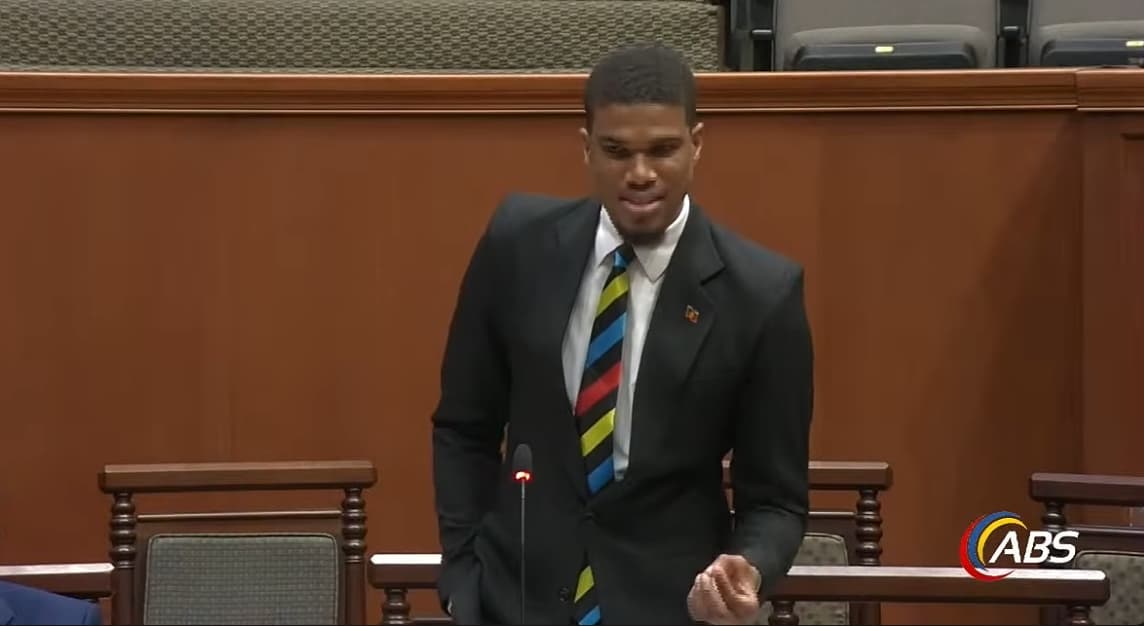
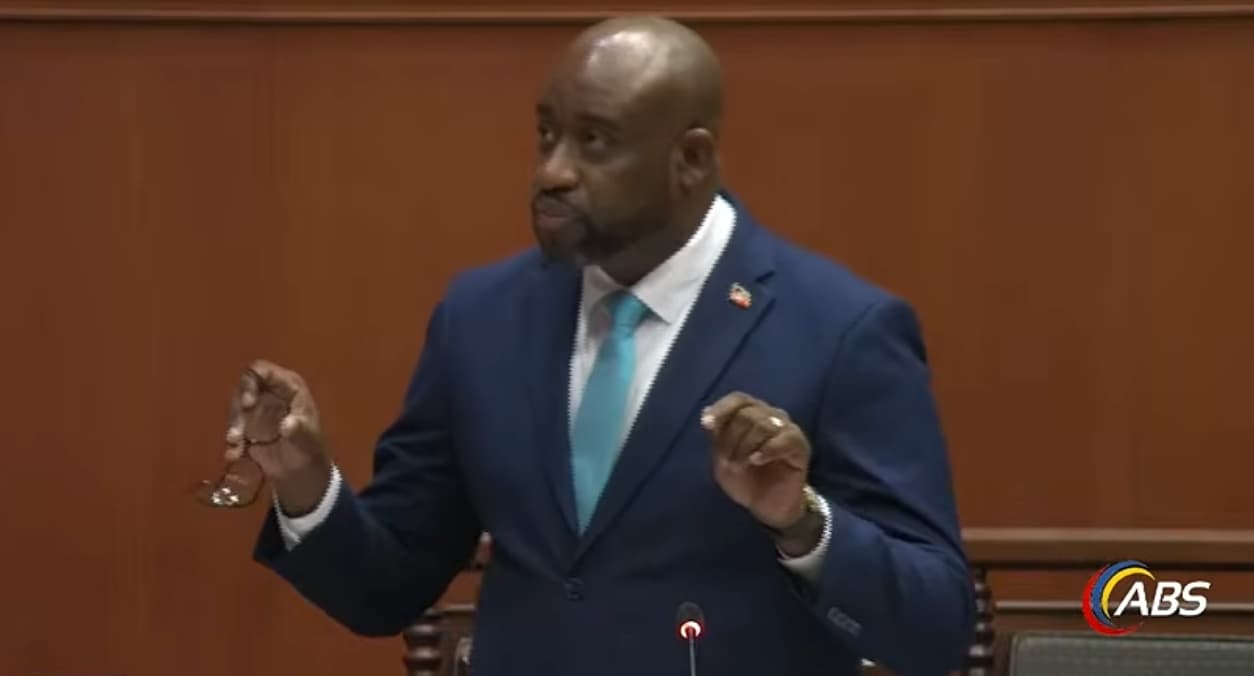
The United Progressive Party (UPP) used a two-hour appearance on Observer Radio's The Big Issues on Sunday to outline how it says it would have handled the recent surge in gun violence, the country's decade-long wait for a forensic laboratory and the deepening crisis in mental health care – while renewing its demand that Prime Minister Gaston Browne withdraw, and apologise for, his threat to deport a sitting judge.
Leader of the Opposition MP Jamale Pringle, Senator Jonathan Wehner, the party's acting public relations officer, and Franz DeFreitas, the UPP's candidate for St. Paul in the last general election, were the guests of host Barbara Arrindell and co-host Eddie Smith on the August 23 programme, which was built around a single question: had the UPP won the April 30th, 2026, general election, how would it have managed the spike in crime, gun importation and mental health in prisons – and should the measures now being rolled out under the police's Operation Restore Confidence have been in place long ago?
Conversation on the Judiciary: 'Withdraw and Apologise'
MP Pringle opened by placing the party firmly behind tough sentencing – and just as firmly against the Prime Minister's August 10th remarks about an unnamed judge.
"The party stands firmly against gun violence and supports strong, lawful sentences for serious firearm offences," he said. "We understand that fighting crime cannot become an excuse for weakening the independence of our courts."
"There must be separation of powers," MP Pringle continued. "I want to join with all the other organisations in calling on the Prime Minister to withdraw that statement and apologise to the judiciary, because it's clear that it can cause serious chaos in the justice system."
At a National Security meeting on gun crime on August 10th, PM Browne referred to "a particular judge who has a propensity to give criminals a break" and said that if the judge could not follow parliament's lead on longer sentences, he should leave the country voluntarily or be deported and declared persona non grata. The remarks have since been condemned by the Antigua and Barbuda Bar Association, the OECS Bar Association, the Caribbean Heads of Judiciary, the Commonwealth Magistrates' and Judges' Association (CMJA) and, in a statement issued last Tuesday, the Commonwealth Lawyers Association. PM Browne has refused to apologise, dismissing the local Bar Association as "defunct" on Facebook, although Foreign Minister E.P. Chet Greene has since written to the CMJA reaffirming the government's commitment to judicial independence and insisting that no judicial officer has been removed, reassigned or deported.
MP Pringle, who had to leave the studio early, closed on the same theme: "We can fight criminals without fighting our institutions. We can strengthen sentencing without threatening judges. We can demand accountability while respecting the constitution. The United Progressive Party will always stand for the safety of our people, the independence of our courts, and the principle that no person – criminal, politician or prime minister – is above the law."
'Interdiction, Prevention, Rehabilitation'
DeFreitas, who contested the St. Paul constituency in April, pointed listeners to the party's published manifesto at myupp.org while stating a UPP government would not have managed crime "by press releases" or as "a flippant reaction" to events, but as a national security, public health and social development issue.
"A UPP government would pursue criminals aggressively, but we would also pursue the conditions producing criminals," he said. "Our approach would have three parts: there would be interdiction, there would be prevention, and then there must be rehabilitation – something that clearly does not exist right now."
"If you have an illegal firearm, you are trafficking weapons. If you are organising criminal activity, the full resources of the state should be brought against you," DeFreitas said. "But you cannot arrest your way out of a social crisis."
He said a UPP administration would bring cabinet, the police, customs, the defense force, the ONDCP, the Ministries of Education, Health and Social Transformation, the youth department, the Director of Public Prosecution's office and the community together under one permanent, high-level operation – rather than what he called a "haphazard" burst of enforcement each time crime spikes – and would revive organised community sport.
"Tomorrow in Antigua and Barbuda, if we start playing more sports and have after-school programmes for children, we will cut maybe in half the problems that we're having," he said, noting that most of the country's violent crime involves young, unsupervised people from families under strain. "Basketball courts don't play sports... When community sports thrived in Antigua and Barbuda, crime was low."
'Intelligence that is not acted upon'
Senator Jonathan Wehner said the state must first admit that "there is intelligence that is not acted upon".
"We know guns are not manufactured here in Antigua and Barbuda," he said. "Are you trying to tell me that after all these years, the law enforcement agencies – from the ONDCP to the police force to all the different special units, and customs – have no clue who are the individuals bringing in illegal firearms?" He said he could not recall anyone ever being arrested, or even questioned, on suspicion of smuggling firearms into the country.
Reading from the police force's own submission in the 2025 Budget Estimates, Senator Wehner listed the "critical issues" the police force itself reported: inadequate facilities, an unavailable Automated Fingerprint Identification System (AFIS), dilapidated buildings, equipment shortages, insufficient uniforms, malfunctioning communication devices and "inaccessible funds allocated for police operations".
"The Minister of Finance is saying one thing, the Minister of Public Safety is saying one thing, but when the rubber hits the road and it's time for the signature to go on the cheque, they can't get the money," he said. "And then the Prime Minister has the gumption to say the police force is not performing, to say the ONDCP is not performing, when you know, as Minister of Finance, that you don't give them the proper resources needed to fight crime."
MP Pringle said the government is "normally reactive rather than proactive" and that he sees no clear strategy on gun importation – "all I'm hearing is a blame game by the Prime Minister". A UPP government, he said, "would have invested in technology and equipment to properly secure our borders, because that's where it starts", would have rebuilt trust between police and communities, revised outdated laws, and confronted youth unemployment and marijuana use among under-18s.
Forensic Lab and Drones
Both DeFreitas and Senator Wehner turned the government's own budget documents against it on the long-promised forensic laboratory. DeFreitas read from the 2023 estimates, in which the Antigua and Barbuda Forensic Services (ABFS) reported they had applied to the cabinet and several ministries on at least 10 occasions since 2016 for a building to house its lab – all declined. Senator Wehner went to page 404 of the 2026 estimates, where the ABFS still lists laboratory and office space as critical needs. Senator Wehner also noted that the ABFS reported in the 2026 budget estimates that its establishing bill remains "pending in Parliament".
"The reason no forensic lab exists in Antigua and Barbuda is because it would actually identify who is in crime," DeFreitas charged. "Crime is organised at a very high level... It is people who have resources. It is people who have access to power."
That skepticism extended to cabinet's consideration last week of a proposed National Beyond Visual Line of Sight (BVLOS) drone surveillance network pitched by a US-based company. "We have no confidence in the government executing these ideas," MP Pringle said, recalling a promise of two maritime surveillance vessels of which "we only got one", and demanding that the government disclose what the system would cost taxpayers. DeFreitas noted that a drone unit would need legislation covering privacy, airspace, data protection and maintenance – "it is taking us 10 years to get legislation for a crime lab" – and asked who would respond when a drone spots a crime, if police already tell callers there is no transport available.
Operation Restore Confidence
Asked whether the intelligence-led searches, checkpoints and patrols now under way under Operation Restore Confidence should have been in place long ago, Senator Wehner said: "I was hoping that those were things that were happening on a daily basis and wouldn't require a special operation." He recalled that murders, disappearances and the shooting of investor Yida Zhang on his own compound happened after the commencement of Operation Iron Grip, a previously announced operation by the police force to arrest the escalating crime situation.
"The biggest thing that the police force can do to restore confidence is not by launching another operation, but by fulfilling their most important duty: to protect the people of Antigua and Barbuda," Senator Wehner said, citing the fatal police shootings of Kahleel Simon in Bolans and Mannie James in Gray's Farm, and the July 23rd death of Rashawn Shabazz following a police-assisted extraction from his cell at His Majesty's Prison. "There are dead bodies in the ground today... because transparency and accountability in law enforcement were not upheld."
DeFreitas said he supported the operation's tactics but not the reactionary or inconsistent deployment of those tactics: "We should not have emergency measures to fix permanent problems." He also asked where Public Safety Minister Steadroy "Cutie" Benjamin has been throughout the crime wave. "We don't hear from him at all."
Mental Health
The panel's final segment turned to mental health, in the shadow of Shabazz's death. "A prison officer is not a psychiatrist, nor a mental health professional. A prison cell is not a substitute for a psychiatric ward," DeFreitas said, proposing mandatory mental health screening at prison intake, periodic clinical reassessment and individual treatment plans decided by doctors rather than prison administrators.
Senator Wehner read at length from the Ombudsman's report on Clarevue Psychiatric Hospital (CPH). The report described sexual scandals, criminals using an abandoned maximum-security ward as their hideout, and a safety petition signed by 113 CPH staff – ending with Dr Marion Blair's conclusion that the hospital "is in need of everything". MP Pringle said strengthening mental health treatment "would have been a priority for the United Progressive Party had we taken office".
Closing the programme, DeFreitas said the Browne administration "has established a demonstrable pattern of too little policy, too little presence and too much reaction... That's not strategic governance; it's crisis management." Senator Wehner said he hoped to return to address what he called "the murder of the reputation of our country" – the link between PM Browne's management of the CIP and the visa restrictions now facing Antiguans and Barbudans.