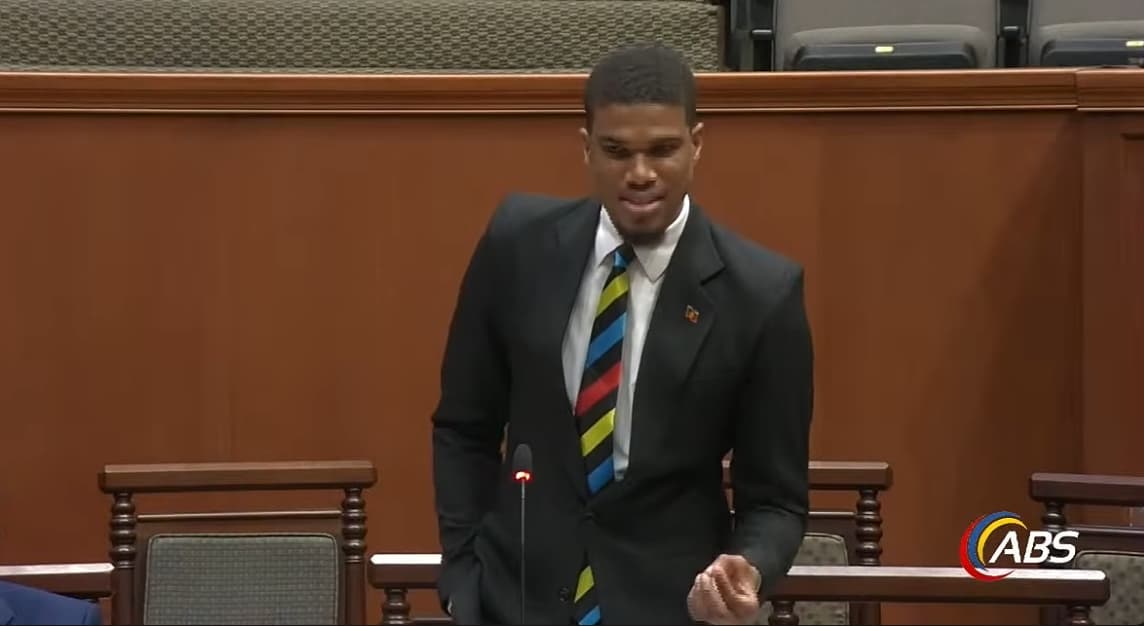
Opposition Senator Jonathan Wehner, the acting public relations officer of the United Progressive Party, has submitted a resolution for the next sitting of the Senate that would give Prime Minister Gaston Browne 14 days to hand the relevant authorities whatever evidence lies behind his declaration that magistrates and judges are "crooks" who "take money from crooks" or publicly withdraw the statement and issue a public apology to the judiciary. The senator also delivered a forensic, clip-by-clip dissection of that declaration and of the Prime Minister's now-infamous advice that criminals should dispose of their "hot" firearms "however they can."
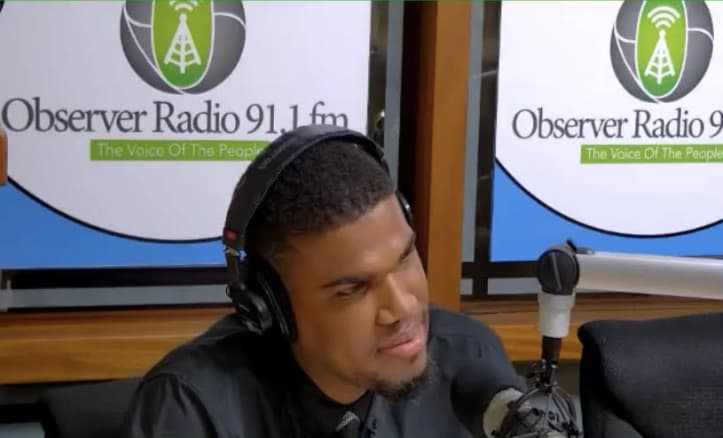
Speaking on Monday, 5th October, on Connecting with Dave Lester Payne on Observer Radio 91.1 FM, where veteran broadcaster Algernon "Serpent" Watts sat in as host, Senator Wehner argued that the two utterances — one undermining the gathering of evidence against gunmen, the other destroying public confidence in the men and women who try them — strike at every stage of the criminal justice system in a country gripped by a surge in gun violence.
"The difficulty I have with this ... is that sometimes in these discussions we have to be very careful that we don't lose sight of reality, because that's how far we have come," Senator Wehner said. "We are losing sight of reality, for the Prime Minister gets up in Parliament and tries to tell us, 'Don't believe your lying ears.'"
The Prime Minister has dismissed questions about both recordings — telling Parliament his firearms comment was "a form of satire" and his words were being "corrupted" for political mischief, and admitting, regarding his remarks of judicial misconduct, that "I have no evidence to send to anyone." Senator Wehner's answer was that satire is no defence, silence is no answer and that either proof or an apology is required for the sake of the public's confidence in the country's justice system.
"Dispose of Them However They Can"
At the Senator's request, the original recording was replayed twice. In it, Prime Minister Browne can be heard saying: "We said to them that we'll put a system in place to collect firearms, provided they have not been involved in any criminal activity. So, if they shot anybody or they kill anybody, we don't want them kind of hot firearms. We expect them to dispose of them however they can."
"Miss Simmons, just to make sure that I am not one who has a hearing problem, could you repeat just the first part of the clip where his original statements are made?" Senator Wehner asked the control-room operator.
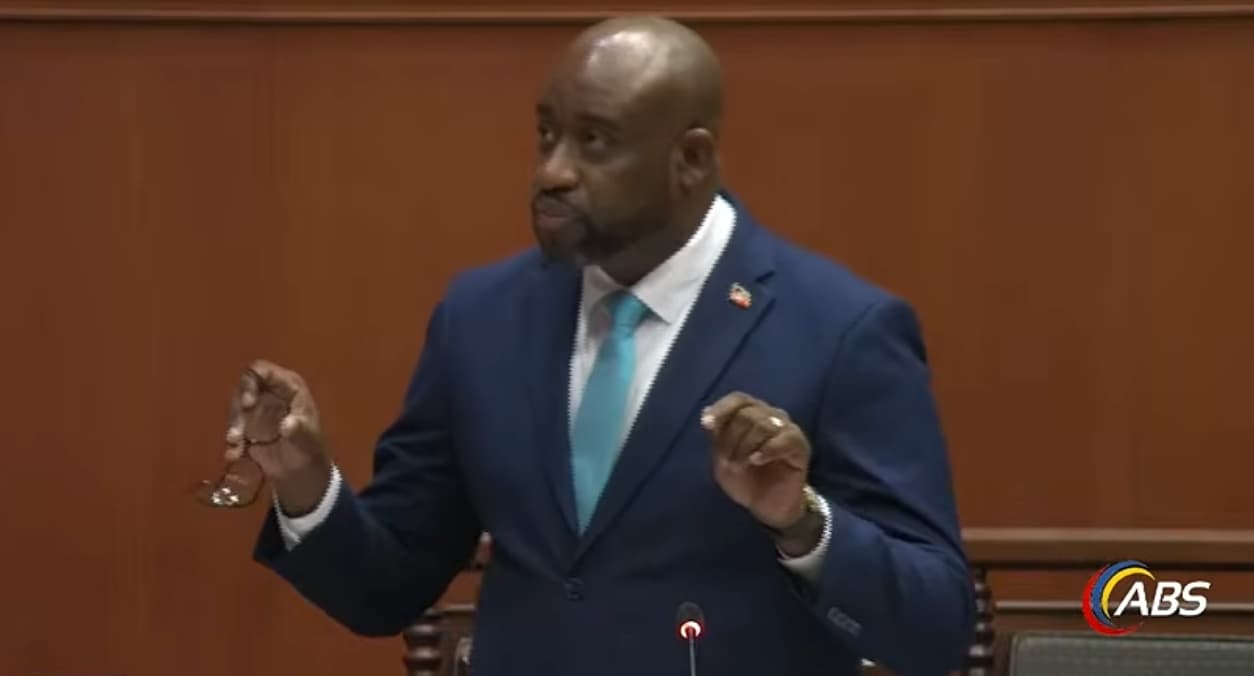
When Opposition Leader Jamale Pringle asked during PMQs at the parliamentary sitting on 28th September whether PM Browne still stood by the statement, the PM accused MP Pringle of "corrupting what I said," described the comment as "a form of satire" that "was never intended to suggest that criminals should commit crime and at the same time discard of their firearms," and dismissed the question as "political mischief" raised in the "wrong place, wrong time" — suggesting such matters belong on radio and social media, not in the parliament.
Senator Wehner was unsparing about that defence. "This clip is now infamous across Antigua and Barbuda. I think there's very few people who could say they have never heard the clip itself," he said. "The Prime Minister said he didn't want illegal firearms used in crimes. He wants the criminals to get rid of those firearms however they can."
As for satire: "So now he is Dave Chappelle. That's his new name — Chappelle," the senator quipped. "So, we have to now assume whenever he goes down to the rum shop station, it's a stand-up routine he's giving. It's satire."
And as for mischief: "Really? That is causing mischief — not your words, which are aiding or advising criminals as to how to get away with their crimes? That doesn't cause mischief?"
A Murdered Mother. A Hampered Investigation?
Senator Wehner anchored his analysis in the case that has shaken the nation: the murder of 20-year-old Saquania Anthony, a pregnant mother of two, gunned down inside her Bathlodge home on the night of 22nd September, in an attack that also left a 13-year-old boy shot in the face and a 24-year-old man wounded.
"We saw a 20-year-old pregnant mother — who is already a mother of two — gunned down, shot to death, murdered in her home. Not walking about, getting herself in any kind of trouble or being places she shouldn't be. She was in her home — her place of safety, security, refuge. That's what your home is supposed to be," Senator Wehner said. "So many gun crimes are being perpetrated upon the citizens and residents of Antigua and Barbuda, and you have a police force coming out and saying, 'We're doing our best. We have Operation Iron Grip, Operation Restore Confidence' ... and the Minister of Public Safety is making these pronouncements. But then you have the Prime Minister of the country telling criminals to get rid of the weapons they use, however they can, but at the same time he's trying to say he's all about cracking down on crime and tougher sentences," the senator remarked.
He then walked listeners through the criminal justice machinery the PM's remark corrodes. "You can only have sentencing if you're convicted. Sentencing is at the end of the criminal justice system. There's an investigation; you have to investigate the crime. Then you have to be charged. Then you have to go through the trial. And at the end of the trial, if found guilty, then you're sentenced. The Prime Minister's comments undermine every single aspect of that criminal justice system."
On the investigation: "How can I properly investigate, as a police officer, the murder of that young woman at Bathlodge, if those criminals listened to the advice given to them by the Prime Minister of this nation and disposed of their hot firearms however they could?"
On the charge: without the weapon, he argued, investigators may never assemble the "probable cause or reasonable evidence" needed. And a search warrant executed after the guns are gone finds nothing.
On the trial itself: "Let's say they dispose of the ammunition too, so there is no ammunition recovered from the scene. They dispose of everything, however they could, according to what that Prime Minister told them to do. Do you think that is going to aid a successful conviction at the end of that trial? No, it's not."
The critique lands at a sensitive moment for the administration, which only days earlier pushed through the Firearms (Amendment) Bill 2026 with stiff minimum sentences for gun crimes — legislation the opposition supported while warning, in MP Jamale Pringle's words, that "if you cannot catch the criminal, this bill serves no purpose" without forensics, firearm tracing and border action. Senator Wehner's point was from the same chain of logic: harsher sentences mean nothing if the evidence that convicts has been "disposed of, however they can."
His verdict on the Prime Minister: "The Prime Minister, who is somehow a genius according to some, has really and truly — well, let me put it nicely — put his foot in his mouth."
"Crooks" on the Bench and "No Evidence to Send to Anyone"
The second clip Senator Wehner put before the public was the Prime Minister's declaration about the judicial bench itself: "We have had magistrates and judges who have been crooks, thieves. Crooks! Take money from the crooks. If you all think I made a mistake when I threatened deportation before — me dead serious." As Real News reported at the time, the declaration immediately raised the question so many are still asking — where is the investigation?
Pressed twice at Prime Minister's Questions by Opposition Leader Pringle on whether he had submitted his information to the ONDCP, the Integrity Commission or the Judicial and Legal Services Commission, PM Browne finally answered: "I have nothing to justify. I have no evidence to send to anyone. It's a statement of fact that is well known within the society." The statement, he maintained, was a "generalised" observation and, once again, raised in the "wrong place, wrong time."
For Senator Wehner, the admission made matters worse, not better. "A prime minister declaring — not alleging but declaring — that the justice system is totally compromised," he said. "Those who sit on the bench, meaning magistrates and judges — we as a society here in Antigua and Barbuda should have no confidence in them because, according to our Prime Minister, they are crooks, one. And two, they accept money from crooks."
The senator spelled out what that means for every citizen with matters before the courts: "How can I — how can you, as a citizen and resident, as a person in Antigua and Barbuda who is seeking justice, whether you're an aggrieved person or an accused person — go into the court to get justice, when you are being told by the Prime Minister of the country that the person who is presiding over your case is a crook? Are they going to accept money from crooks? What kind of confidence can I have in my justice system?"
Host Algernon Watts drew his own conclusion from the two parliamentary defences played side by side: on radio, it seems, there are no standards — "when you're confronted about what you say on radio you say, one is satire, and two, you say, well it's radio." Senator Wehner's reply focused on the mindset of the people. He noted the irony of Antiguans who nightly condemn President Donald Trump's conduct as unstatesmanlike "and then get on social media and laugh at, clap, applaud and praise our Prime Minister for doing" the exact same thing. "Is it because we have a low estimation of the standing of the nation of Antigua and Barbuda that anybody who holds that office can behave any way, any how?"
"Resign or Be Put Behind Bars" — The ONDCP Problem
Senator Wehner then turned the Prime Minister's own portfolio against him. The Office of National Drug and Money Laundering Control Policy (ONDCP), he reminded listeners, falls under the Prime Minister's own ministry — "perhaps the biggest ministry of all of them" — and its mandate is "to investigate the proceeds of crime."
"A criminal element bribing a judge, and the judge pocketing money — that is money from the proceeds of crime," the senator reasoned. And, citing a recent interview on Observer Radio's Voice of the People hosted by Adrian Williams, in which a long-serving ONDCP senior supervisor explained that the agency acts on case files submitted to it — by its director or by the minister responsible — Senator Wehner noted the same official revealed that "there has been no case file submitted to the ONDCP for years."
The conclusion, as Senator Wehner framed it, is inescapable: "If he, within his statement on radio, said magistrates and judges — not alleging, but declaring — are crooks and accept money from crooks, and in Parliament said that it is a fact well known in society, you as a minister either need to resign or need to be put behind bars. Because you through your inaction are facilitating those judges and criminals — the judges who accept the bribes and the criminals who bribe the judges — because you know it's well known in society that this is happening, and there has not been any investigation launched by the ONDCP."
"There has not been any person who has been brought in for questioning for bribing any member of the judiciary, magistrate or judge," he continued, "and there has been no magistrate or judge — member of the bench — who has been brought in for questioning or charged for accepting bribes."
Taking the Prime Minister's "satire" seriously, Senator Wehner pressed the point to its logical end: "I stand by my statement that individuals belong behind bars because, in my mind, some people are accessories after the fact. Because you are enabling this system of bribery and corruption — crooks and thieves, according to you — to continue to perpetuate and to multiply within the justice system in Antigua and Barbuda. And therefore we as citizens and residents, if we are to take your satire seriously, should have no confidence in our justice system."
Breaking on Air — A Resolution Demanding Proof or a Public Apology
Then came the announcement Senator Wehner billed as breaking news. "I drafted a resolution," he revealed, one that "affirms the constitutional role, independence and impartiality of the judiciary, denounces judicial misconduct and bribery, and calls upon the Prime Minister to furnish the relevant authorities with the information supporting his public declarations concerning judicial misconduct and bribery or, in the absence of such information, to apologise to the judiciary."
"I took my time to make sure it is not something that can be perceived as a fly-by-night, superficial or surface-level approach. Proper research was done into this," he said, before reading the document in full on air.
The resolution is grounded clause by clause in the Constitution: Section 1 (Antigua and Barbuda as a "unitary sovereign democratic state"), Section 2 (the Constitution as supreme law), the preamble's recognition that "the state is subject to the law," Section 15(1)'s guarantee of a fair hearing "by an independent and impartial court established by law," the separation of powers among Parliament (Section 27), the executive (Section 68) and the courts, the entrenched protections of Section 47, and Section 103 which vests discipline and removal of magistrates in the Governor-General acting on the advice of the Judicial and Legal Services Commission — what the resolution describes as "the lawful constitutional channel for the investigation and determination of allegations of misconduct against judicial officers."
At its core sits a simple contrast. The Prime Minister's declaration, the resolution states, is "an allegation of judicial bribery and corruption of the utmost gravity, which follows from one of only two possibilities: either the Prime Minister possesses information supporting his declaration, in which case that information must forthwith be furnished to the competent authorities so that it may be investigated according to law; or the Prime Minister possesses no such information, in which case his declaration inflicts grave and unwarranted injury upon the reputation, independence and impartiality of the judiciary, and upon public confidence in the administration of justice."
Its operative clauses would have the Senate:
Affirm the judiciary's essential constitutional role and its independence and impartiality as "a pillar of the separation of powers in a liberal democracy," declaring that "no member of the executive or of the legislature may properly seek to direct, intimidate, punish, or retaliate against any judicial officer for the discharge of judicial functions";
Denounce judicial misconduct "in any and every form in which it may manifest itself, including judicial bribery," affirming that credible information of such misconduct "must be placed before, investigated by, and determined through the lawful authorities and due process of the law, and never left to public accusation without process";
Call on Prime Minister Browne, within 14 days of the resolution's passage, "to furnish the Judicial and Legal Services Commission, the ONDCP and the Integrity Commission with all the information, evidence, and particulars in his possession or under his control" supporting his declaration, "so that investigations may forthwith be launched by those bodies in accordance with the law";
Failing that, call on him "to publicly withdraw his declarations of judicial misconduct and bribery, and to tender a public apology to the magistrates and judges of Antigua and Barbuda, and to the judiciary as an institution"; and
Direct the Clerk of the Senate to transmit certified copies to the Prime Minister, the Attorney General, the Chief Justice of the Eastern Caribbean Supreme Court, the Judicial and Legal Services Commission, the Director of the ONDCP and the Chairman of the Integrity Commission.
Senator Wehner says the procedural groundwork is airtight. "I crossed all my T's and dotted all my I's. Did everything I had to do. Submitted it well in advance, so there is no excuse — in my mind, at least … as to why this should not be on the order paper, why it should not be debated, and why it should not pass," he said, explaining that he went public precisely so the people would know if the resolution mysteriously fails to be debated when the senate meets this month.
"This matter … is a matter of the utmost importance, and we must get to the bottom of this," he said, "because if there is no justice, we are a lawless nation."
Watts, a former parliamentarian himself, hailed the move: "You went through all your legal channels, the proper protocol, and you're letting the public know … The power of the people is greater than the people in power."
Regional Fallout and the Road to the CCJ
The resolution also records the condemnation PM Browne's August 2026 remarks — in which he threatened the deportation of a judge who, in his opinion, did not "follow the lead of Parliament" on sentencing — drew from the Antigua and Barbuda Bar Association, from the Caribbean Heads of the Judiciary in a joint statement, and from the Commonwealth Magistrates' and Judges' Association. As Real News has reported, the Bar Association warned the remarks amounted to "executive coercion" and a "grave threat" to judicial independence — and received a two-word dismissal from the Prime Minister in reply: "piss off".
Senator Wehner stressed that the damage does not stop at the shoreline. "We cannot escape the fact that persons who sit on the bench here in Antigua and Barbuda are not just Antiguans and Barbudans," he said. "You're bringing into disrepute the magistrates and judges throughout the entire OECS, because there's a rotation." By extension, he argued, the Prime Minister is branding jurists who could one day ascend to the Caribbean Court of Justice as "corrupt thieves, crooks, and persons who accept bribes."
That, for Senator Wehner, is the bitter irony. "Let me be very clear, I want to see Antigua and Barbuda [accede] to the CCJ. That's something I want to see done. But the Prime Minister is destroying his own position," he said, recalling the failed referendum of 2018. "He is proving the argument of those who opposed it way back when … the whole argument was 'trust is a must.' "
The senator closed by rejecting any suggestion that the resolution is political theatre. "This is not something that I'm doing to score cheap political points. This is a matter of serious concern," he said before reminding listeners that he knows the inside of a courtroom as a defendant himself, having been numbered among citizens hauled before the magistrate's court for accessing a public beach. That story, and the people's fight over Jolly Beach and Social Security, forms the subject of a companion report.
Speaking to the expectation that the Senate will meet before the end of October Senator Wehner pledged, "We will prepare as opposition senators, as we always do, and I can guarantee you, the people of Antigua and Barbuda, that we will deliver on your behalf, God willing."