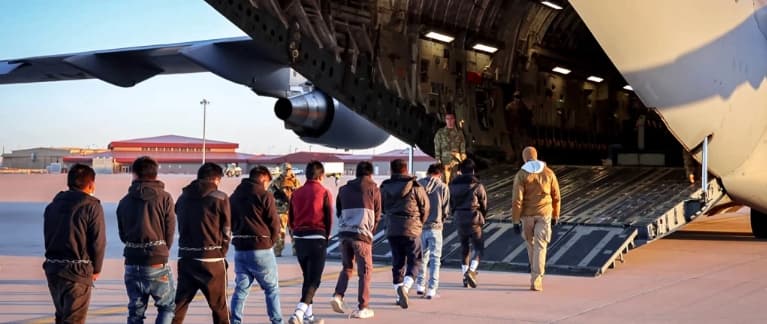
Prime Minister Gaston Browne claims he has drawn a firm line in the sand with the United States over the controversial third-country deportee plan, revealing that his government has rejected a proposal to accept 120 individuals annually and counter-offered a strict cap of just ten per year — while warning that the Caribbean is being "coerced" into compliance by Washington through threats to visas, economic assistance, and the region's Citizenship by Investment programmes.
But as the Prime Minister speaks publicly about the pressure being applied by the United States, a critical question is being raised by observers and commentators across the country: why has none of this been brought before Parliament? Antiguans and Barbudans are learning the details of their government's negotiations with the most powerful nation on earth not through parliamentary debate, but through a speech delivered at a regional summit and utterances on the PM's radio station.
"We Have Been Coerced"
Speaking during his first address as incoming Chairman of the Organisation of Eastern Caribbean States Authority at the Royalton Resort in Deep Bay, Browne made the unusual disclosure that Antigua and Barbuda has been facing direct pressure from the United States to accept deportees who are not citizens of the twin-island nation.
"We have been coerced to take these deportees," Browne told the assembled heads of government. "Encouraged by the great United States. And if we don't cooperate, they punish us."
Adding that his government has insisted it would not accept any criminal elements among those sent to the country PM Browne stated, "As the Prime Minister of Antigua and Barbuda, I cannot willingly cooperate with any other power, any country, to destroy our beautiful twin-island state."
120 Rejected; 10 Counter Proposed
Browne disclosed that Antigua and Barbuda was asked to consider accepting 120 individuals annually — a figure he described as "totally unacceptable." His administration has submitted a counterproposal capping arrivals at ten per year. "We have sent them a counterproposal. We said that we'll accept 10 annually, no more than 10," Browne said. "I hope that this will not result in any acrimony and further restrictions, but that they will respect our position and respect our sovereign right to determine how many of those individuals we accept."
A Glaring Absence of Parliamentary Scrutiny
While the Prime Minister has chosen to disclose elements of the negotiations at a regional summit, what he has conspicuously not done is bring any of those proposals — or any agreement reached — before the Parliament of Antigua and Barbuda. The nation's elected legislators have not been given the opportunity to debate the US proposals, scrutinise any counteroffers made in the name of the Antiguan and Barbudan people, or examine the terms of any arrangement that may have been agreed between the two governments.
This absence of parliamentary transparency stands in pointed contrast to the approach taken by Jamaica. When Jamaica reached its agreement with the United States — under which it agreed to accept up to 25 refugees every two weeks and to serve as a transiting point for deportees bound for other locations — the Jamaican government brought that Memorandum of Understanding before its parliament. Jamaican legislators were given the opportunity to see, debate, and scrutinise what their government had agreed to with Washington.
Antigua and Barbuda's Parliament has been given no such opportunity. The country is being asked to trust that the Prime Minister's counterproposal — a cap of ten individuals per year — represents the full and complete picture of what is being negotiated, without any of the formal, accountable, parliamentary scrutiny that a matter of this magnitude demands.
This is not a minor administrative arrangement. It is a negotiation with the United States government over who enters Antigua and Barbuda, under what conditions, and with implications for public safety, national security, sovereignty, and the relationship between the two nations. It is precisely the kind of matter that Parliament exists to oversee.
The Stick Behind the Request