Edition
Real News Antigua & Barbuda

PM Browne Declares Magistrates and Judges "Take Money from Crooks": So Many Ask — Where is the Investigation?

Editorial Staff
Editorial StaffReal News Editorial Team
7 min read
ShareXFacebookWhatsApp
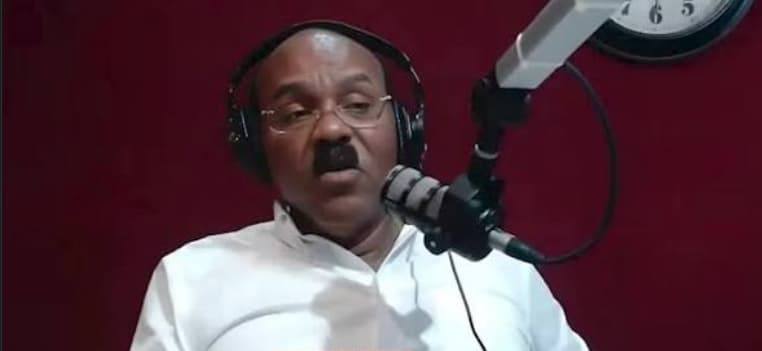
gaston browne on radio

Prime Minister Gaston Browne has escalated his month-long war with the judiciary to a new and far more dangerous plane, using his Saturday radio programme to accuse unnamed magistrates and judges in Antigua and Barbuda of being "crooks" and "thieves" who "take money from crooks" — and to double down on his earlier threat to deport members of the bench.

"We have had magistrates and judges who have been crooks, thieves, crooks. They take money from crooks," the Prime Minister declared. "If y'all think I made a mistake when I threatened deportation before, me dead serious!"

The remarks are no longer merely intemperate political rhetoric. They are, on their face, an allegation of judicial bribery and corruption — one of the most serious criminal accusations that can be levelled in any democracy. And they invite an obvious question that the Prime Minister has so far shown no inclination to answer: if he knows this to be true, why has no investigation been launched?

Why the Minister Responsible for the ONDCP has NOT Used the Tools at his Disposal?

Gaston Browne is not a talk-show caller. He is the head of government and the minister with responsibility for the Office of National Drug and Money Laundering Control Policy (ONDCP), the very agency empowered to trace illicit payments, investigate money laundering, and follow dirty money wherever it flows — including, if the Prime Minister's claim is to be believed, into the pockets of judicial officers.

Yet, there is no indication that the ONDCP has opened any inquiry into judicial corruption. No file, so far as the public knows, has been transmitted to the Director of Public Prosecutions. If the Prime Minister possesses information sufficient to state with such confidence — "me dead serious" — that members of the judiciary have been accepting money from criminals, the proper course is not a radio monologue. It is a referral to the DPP, whose constitutional office exists precisely to receive such evidence and to prosecute without fear or favour. That referral, to date, has not happened. The public is entitled to ask why.

The Silence of the Integrity Commission

Equally deafening is the silence of the Integrity Commission. Under the Integrity in Public Life Act, judicial officers are among the persons in public life required to declare their income, assets and liabilities to the Commission. If judges and magistrates were truly banking bribes from "crooks," those unexplained funds should surface — or conspicuously fail to surface — in their statutory declarations.

In Jamaica, that country's Integrity Commission has repeatedly demonstrated what an empowered oversight body looks like, launching investigations into public officials — up to and including sitting prime ministers — and publishing its findings, however uncomfortable. Antiguans and Barbudans watching this saga unfold are entitled to ask: where is our Commission? A head of government has publicly alleged that officers of the court are on the take. If that allegation does not trigger an inquiry, what would?

A Pattern of Attack, Not an Isolated Outburst

Saturday's comments cannot be divorced from the storm the Prime Minister ignited in August. During a national security meeting on August 10th, PM Browne suggested that a judge could be deported from Antigua and Barbuda if he did not "follow the lead of the Parliament" by imposing longer criminal sentences. Addressing the unnamed judge directly, he said: "Brother man, if you cannot follow the lead of parliament to give longer sentences, leave our country voluntarily otherwise we are going to deport you and make you persona non grata. You know who you are. This is the Prime Minister of the country saying this."

The condemnation was swift and near universal. The Antigua and Barbuda Bar Association (ABBA) called on the Prime Minister to withdraw the threat, warning that the remarks pose a "grave threat" to judicial independence and the rule of law. ABBA argued that a public threat by the head of government directed at the judiciary "is itself an act of executive coercion," with a chilling effect that is immediate whether or not the threat is ever carried out. The Prime Minister's response to the local bar association's call for an apology was two words: "Piss off."



Advertisement

Article mid


The Caribbean Heads of Judiciary issued a joint statement on August 12th condemning the remarks, and the Commonwealth Magistrates' and Judges' Association followed with what was seen as the strongest rebuke yet, saying it was "extremely concerned" about the attacks and warning that democracy would be "gravely undermined" if court judgments are not respected. The Association pointedly noted that with Antigua and Barbuda set to host the Commonwealth Heads of Government Meeting later this year, the country "should be setting an example in protecting and promoting the rule of law and the separation of powers."

Notably, PM Browne responded on August 13th by insisting his comments did not amount to an instruction against any judge, and that "there has never been any request or action" by his government "to remove or reassign or deport any member of the judiciary". Saturday's declaration — "me dead serious" — makes that retreat impossible to sustain. The Prime Minister has now confirmed, in his own words, that the threat was intended exactly as it sounded.

How does This Square with the CCJ Campaign?

The Prime Minister has long pushed for Antigua and Barbuda's transition from the London-based Privy Council to the Caribbean Court of Justice (CCJ) as the nation's final appellate court — a move rejected by voters in the 2018 referendum, in part because the public was not persuaded to place its full trust in regional judicial institutions.

It is difficult to conceive of a more effective way to sabotage that cause than for the head of government to tell the nation that the region's magistrates and judges — the very pool from which future CCJ jurists will be drawn — are "crooks" and "thieves" in the pay of criminals. If the Prime Minister genuinely believes the regional bench is for sale, how could he seriously ask citizens to entrust it with final appellate jurisdiction? And if he does not have any evidence to support his claims of judicial corruption, what does it say that he would recklessly torch public confidence in the administration of justice for the sake of a radio soundbite?

Is the Prime Minister Himself Exposed?

There is a final question, and it is an uncomfortable one. The criminal law does not look kindly on those who have knowledge of serious offences and sit on it. A person who knows that felonies - bribery, corruption, the receipt of criminal proceeds - have been committed, and takes active steps that assist offenders in evading justice, risks liability as an accessory after the fact.

The Prime Minister says he knows that judicial officers have taken money from crooks. He has named no names, referred nothing to the DPP, tasked no agency under his authority with investigating, and has allowed the allegedly corrupt members of the judiciary to continue to preside over cases in this country. Antiguans and Barbudans are entitled to ask whether that inaction amounts to a cover-up by omission, and whether the same legal standards the Prime Minister demands the courts apply harshly to gunmen and robbers should not also be applied to a head of government who, by his own account, is sitting on evidence of corruption at the heart of the justice system.

Either the Prime Minister has evidence, in which case his duty is to hand it over — or he does not, in which case he has defamed an entire arm of the state and gravely damaged the international reputation of Antigua and Barbuda mere months before it welcomes the heads of government of the Commonwealth to its shores.

Neither possibility reflects well on him.

The nation awaits his answer.

Comments

Leave a comment

Comments are moderated before appearing.

Weekly Digest

Stay ahead of every story that matters.

Every Monday morning — the week's most important news from Antigua & Barbuda and the Caribbean, delivered straight to your inbox.

  • Breaking news & top stories
  • Politics, crime, business & sport
  • Free — unsubscribe any time

No spam. One email per week. Unsubscribe any time.

or
Join our WhatsApp group

About the author

Editorial Staff
Editorial Staff

Real News Editorial Team

Real News Antigua and Barbuda editorial team.

Advertisement

Leaderboard ad

Related articles

Advertisement

M Banner
Join our WhatsApp