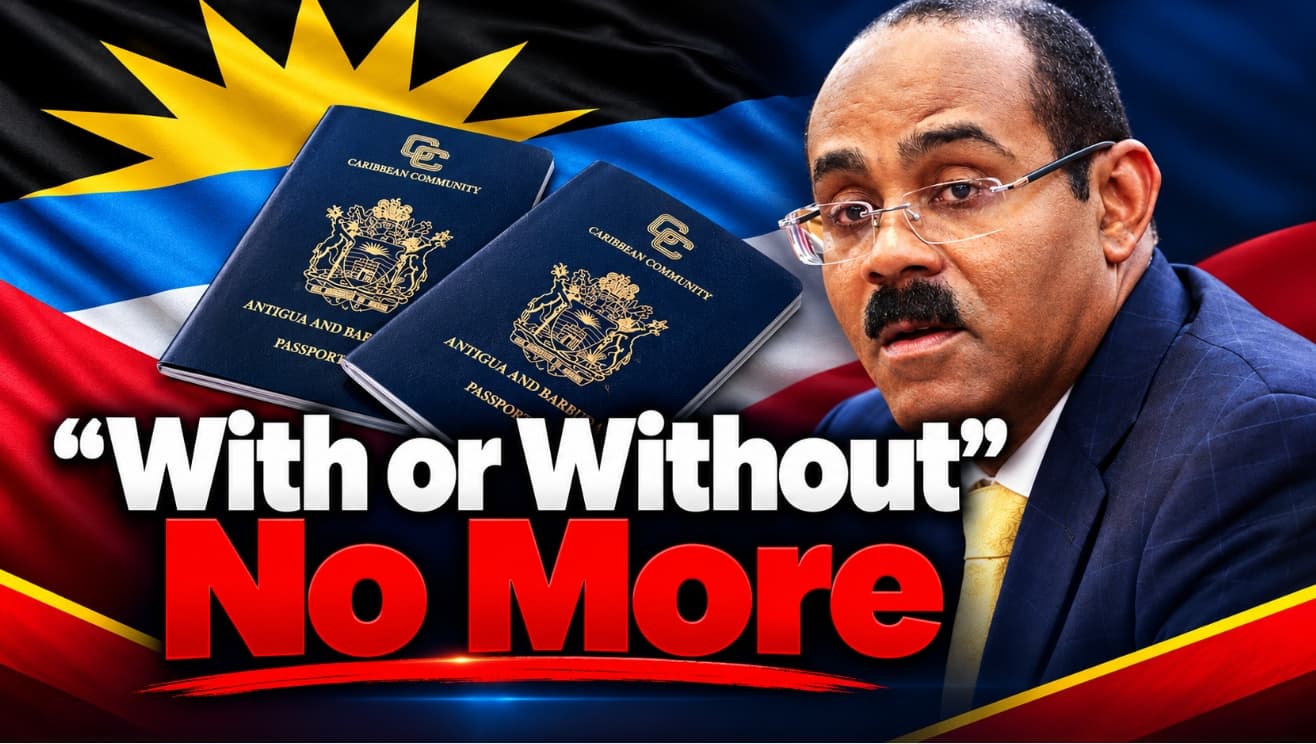
Prime Minister Gaston Browne has announced that Antigua and Barbuda will "very likely" suspend its Citizenship by Investment Programme (CIP) by November 12 in order to preserve visa-free access to Europe's Schengen Area — a stunning capitulation from the man who, only four months ago, vowed the programme would continue "with or without" Europe's visa-free arrangements, and who for a decade presided over the dismantling of the very safeguards which helped to bring the programme to this point.
Speaking on his Browne and Browne radio programme on Saturday, the Prime Minister disclosed that European Union officials, in a technical meeting earlier in the week with representatives of the five OECS countries operating citizenship programmes, laid out a stark binary: the countries may keep their programmes and lose Schengen visa-free access, or commit by November 12 to suspending them and retain the travel privilege for their citizens, according to reports by the Antigua Observer.
"We can continue our programs as we wish, but we would not continue to enjoy visa-free access into the Schengen area," PM Browne explained of the first option. On the direction Cabinet is leaning, he was unambiguous: "No final determination has been made, but based on the preliminary discussions, it's very likely that Antigua and Barbuda will suspend its CIP program come November 12th."
The Prime Minister has called for a meeting of OECS heads of government for early this week in search of a common regional position — while conceding that, because visa-waiver arrangements are bilateral, "each country obviously will have to take an independent decision" if no consensus emerges. However the regional diplomacy resolves, the political fact is already established at home: the hardline position Gaston Browne staked out all summer has collapsed. What follows is the story of that collapse and of the decade of mismanagement that made it all but inevitable.
From "With or Without" to "Very Likely" — Anatomy of a 180
To grasp the scale of Saturday's reversal, one need only rewind to late June. With the EU's threat to Schengen access freshly confirmed at the 78th Meeting of the OECS Authority, the Prime Minister went on radio and drew a defiant line in the sand: "With or without those visa-free arrangements, our CIP programme continues. It is too important a source of non-tax revenue to give it up."
That was no off-the-cuff remark. It was a position PM Browne repeated and reinforced at every turn. When the European Commission's June 25 letter from Commissioner Magnus Brunner formally demanded the complete phase-out of the CBI programme by June 1, 2028, the government's official response was firm: Antigua and Barbuda would not agree to a unilateral phase-out without "viable, concrete, and credible" replacement revenues — pointedly noting that Brussels' proposed development support had never been quantified. In July, as the five OECS CIP nations met to craft a unified response, the Prime Minister warned that an EU visa suspension would cause "irreparable harm" to OECS economies. He defended the programme's integrity internationally, insisted Antigua's system was "better run" than those of the countries criticising it, and held out hope for a middle-ground Electronic Travel Authorisation rather than any suspension of visa-free access.
Four months later, every plank of that position has given way. There is no announced ETA compromise. There are no announced replacement revenues — the precondition the Prime Minister himself set for any retreat. The programme he declared "too important" to surrender under any circumstances is now, on his own account, "very likely" to be suspended within seventeen days. The man who told the nation he would stare down Brussels is preparing to blink, and nothing in his Saturday remarks explained what, if anything, Antigua and Barbuda extracted in return.
What Changed — Brussels Turned its Threat into Law
Part of the explanation lies in Brussels. The EU's position hardened from diplomatic pressure into binding legal machinery. Under the revised Visa Suspension Mechanism — approved by the Council of the European Union in November 2025 and in effect since December 2025 — the mere operation of an investor citizenship scheme, defined as granting citizenship for predetermined payments or investments without a genuine link to the country, is now an independent ground for suspending visa-free travel. A first suspension runs for twelve months and can be extended by a further twenty-four — potentially locking Antiguan and Barbudan travelers out of visa-free Europe for three years.
Nor is the threat theoretical. The EU has already removed Vanuatu from its visa-exempt list over its investor citizenship programme — the precedent that proved Brussels will pull the trigger. And the European Commission's December 2025 report, while acknowledging regional reforms such as the harmonised US$200,000 minimum investment threshold and strengthened screening, continued to flag short processing periods and low rejection rates as unresolved concerns.
But that shift tells only half the story. The other half is why Antigua and Barbuda arrived at this showdown with no credibility left to spend, and that half is a story of this government's own making.
The Decade That Destroyed the Programme's Credibility
The Prime Minister spent the summer telling Brussels, Washington and the general public that the CIP is run with integrity. The documented record — much of it assembled by the opposition from the government's own laws, reports and parliamentary admissions — tells a different story, and it is that record which stripped Antigua and Barbuda of any standing to argue its case.
The audit requirement was repealed by PM Browne himself. On March 30, 2016, the Browne administration passed the Antigua and Barbuda Citizenship by Investment (Amendment) Act, No. 2 of 2016, which repealed Section 2J of the original 2013 Act — the provision requiring the Citizenship by Investment Unit's accounts to be audited by the Director of Audit or an approved auditor. Opposition Senator Jonathan Wehner, reading the provisions back on Observer Radio in September, branded that legislation "the gun that killed the integrity of the CBI programme" and declared that the Member for St. John's City West "shot to death the reputation of Antigua and Barbuda" on the floor of Parliament.
A decade without a single audit. The consequence was exactly what the repeal invited. In his July Senate contribution, Senator Wehner revealed written confirmation from the Director of Audit that the CIU's accounts have not been audited by that office, or any auditor approved by it, since 2016. The last audits on the parliamentary record being KPMG's examination of the 2013 and 2014 accounts. This for a programme budgeted to deliver EC$120 million to the Consolidated Fund in 2026 alone.
"I don't know." When Barbuda MP Trevor Walker asked the Prime Minister directly in the House of Representatives when the CBI Unit was last audited, the Prime Minister — the minister with direct responsibility for the CIP — gave a three-word answer: "I don't know". "Unacceptable," MP Walker replied. "You are the Minister of Finance. You should know."
The law that survived but was simply ignored. Regulation 13(2)(f) requires each of the CIU's six-monthly reports to name the projects, charities and businesses receiving CBI payments. Of twenty reports published since the programme's inception, only one — the 2015 report — has ever complied. The 2016 amendments also stripped applicants' names and addresses from the reports, leaving only nationalities, so the public can no longer know who is acquiring the nation's citizenship. "The laws he didn't change, he just refused to follow," Senator Wehner charged.
Guardrails dismantled across the board. Opposition Leader Jamale Pringle has detailed the broader 2016 dismantling: residency requirements cut from 35 days to five, investment approval powers transferred from the CIU and the Antigua and Barbuda Investment Authority to the Prime Minister, and the minister handed the power to hand-pick which charities receive National Development Fund allocations.
Due diligence failures with names attached. The vetting once touted by PM Browne as world-class granted Colombian businessman Alex Saab not merely citizenship but a diplomatic passport and an appointment as special economic envoy to Venezuela — despite money-laundering investigations dating back to 2012. Saab has since pleaded guilty in a Miami federal court to money laundering, agreeing to forfeit roughly US$195 million. Senator Wehner has also pointed to the ten CIP files the Prime Minister acknowledged are linked to Nigeria's Onyema family, members of which were indicted by the US Department of Justice on bank fraud and money-laundering charges.
The numbers Europe actually looked at. Circulating the European Commission's eighth visa-suspension report in the Senate, Opposition Senator Malaka Parker highlighted its findings: an estimated 107,625 passports issued across the five Eastern Caribbean schemes, with Antigua and Barbuda's 2024 rejection rate of 1.7 percent being the lowest in the region, and Syria, Iraq and China ranking among the top source countries for successful applicants. "When people are beating their chests — 'oh, we have one of the best programmes' — they feel that by the strength of their language they can make a lie into the truth," Senator Parker said.