On the eve of the June 2014 general election, then Opposition Leader Gaston Browne made the people of this country a promise: under his government, the people would "live in communities with proper streets, roads, drainage, electricity, water, sanitation and modern amenities comparable to that of a developed country."
Twelve years, four consecutive election victories and — by the administration's own accounting — hundreds of millions of dollars later, the Antigua Public Utilities Authority (APUA) spent June 2026 reminding residents not to attach hoses to public standpipes, which it described as shared resources for "households that may not have direct access to a potable water supply." The Governor General was appealing for public patience over pipes that split, leak and break. And the Prime Minister's advice to a nation still enduring dry taps was to "blaze the minister."
Let us review the Gaston Browne administration's own words across the twelve years of 2014-2026 — using statements by Prime Minister Browne, former utilities minister Sir Robin Yearwood and current public utilities minister MP Melford Nicholas, together with campaign rally speeches, APUA briefings, cabinet notes, three ABLP manifestos and two throne speeches — to reveal a cycle that has repeated with remarkable consistency: a bold production promise, a missed deadline, a new and larger target, and a fresh explanation for why the water still does not reliably reach the tap. The one thing the cycle has never produced is the unforgettable promise on that election eve in 2014: consistent running water.
"Water must Flow through the Pipes at All Times"
The standard against which this administration should be judged is the one it wrote for itself. The ABLP's 2014 manifesto declared, on page 9, that "water must flow through the pipes at all times," except when an emergency forces a shut-off.
And in April 2014, weeks before the polls, the party flatly rejected drought as an excuse for the then-UPP government's water failures. "With the widespread availability of reverse osmosis and desalination technology, our country should not be in this water crisis in which … our residents have to resort to using buckets to bathe," the party stated. "Our country is not unaccustomed to droughts and … yet the shortage of water has never been this bad."
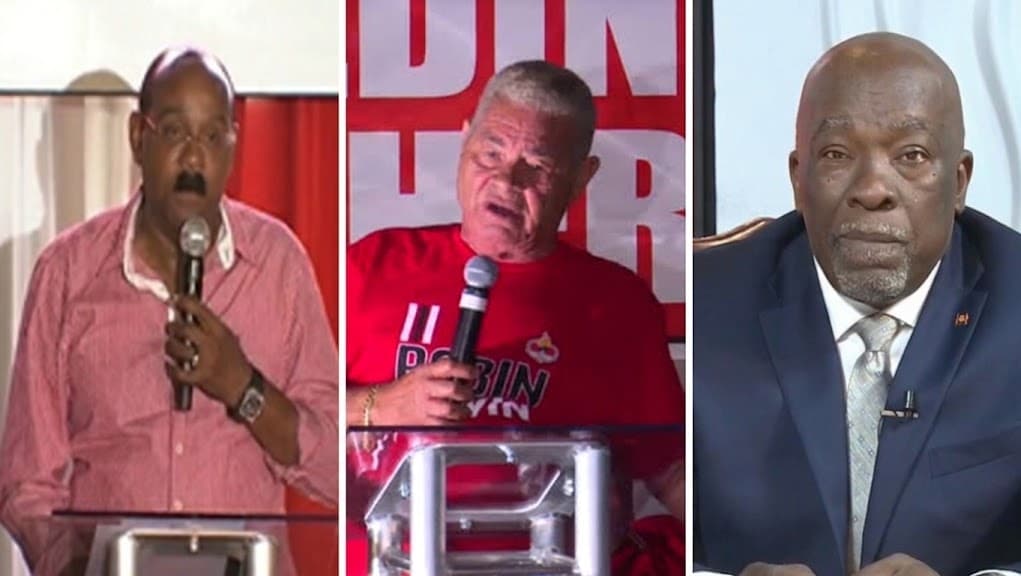
No one made that case more vividly than Sir Robin Yearwood himself. From an ABLP rally platform, while the party was still in opposition, the man who would go on to become one of the longest-serving ministers responsible for water catalogued the daily indignity of life without it. "We cannot invite our friends for carnival," he told the crowd. "Mothers can't do nothing planned properly with no water." He pressed on: "When you leave work, or you leave wherever you go, you cannot go on and turn a faucet and have a shower" — and asked how anyone could vote for "a government that is depriving you of the most essential, essential item": water. "What happened to your children? What happened to your cooking of your food?" he demanded, invoking schoolchildren, wives and grandmothers struggling to keep cool in the heat.
Then came the pledge that would define everything after it. "Under Labour, let me tell you, God will send a drought, but God have His sea, and under Labour that sea water will come fresh water, and under Labour you will never know drought from when plenty rain a come." Drought, in other words, was God's business — and under an ABLP government, God's sea would answer it so completely that Antiguans and Barbudans would not be able to tell the dry years from the wet. As for any government that deprived its people of water, Sir Robin supplied the verdict himself: anyone who voted such a government back into power was, in his words, "a wicked non-Antiguan and Barbudan."
By the ABLP's own 2014 logic, drought is no defense where desalination or reverse osmosis exists. It is a standard the ABLP has spent the following twelve years asking the public to forget. By May 2022 the same party was describing "the worst decade of drought in the history of our country, that has eliminated all of our surface and ground water sources," and by that September the Prime Minister was telling Antiguans in New York that "for the first time in the history of our country," climate change had dried both surface water and the aquifers.
"Feel Proud, Antiguans"
However, in August 2017, the ABLP, via a post on their Facebook page, declared the problem effectively beaten. "Antigua needs approximately 5.5 million gallons per day sometimes 6.0 million gallons per day," the ABLP announced. "We can now produce 7.7 million gallons per day R.O. WATER. FEEL PROUD ANTIGUANS." In the same statement it pledged: "We will be tackling and replacing burst mains NOW."
The 2018 manifesto pressed the point, claiming on page 19 that the ABLP had "delivered the end to the UPP water drought," that the EC$22 million Sembcorp arrears had been extinguished, and that old and defective pipes would be replaced so that every household could count on reliable supply in the coming year of 2019.
Take the ABLP's 2017 arithmetic at face value and the conclusion is inescapable: daily water production exceeded national demand 9 years ago, and the crisis should have ended then. Either the figures were wrong, or the water was being produced and never reaching the people.
Two Million Gallons Lost Daily
The government has known which of the two it was since at least March 2018, when Sir Robin Yearwood, then the minister responsible for APUA, reported that almost two million gallons of potable water were leaking from broken pipes every day. Replacement of the old mains, estimated at a few million dollars, would be undertaken "virtually simultaneously" with the repaving of roads across the island, cabinet said at the time, as reported in the cabinet notes.
Four and a half years later, in September 2022, the government was still at the study stage: the agreement Prime Minister Browne signed with Malta established a "Pilot Leakage Management Project" — a pilot — five years after the party promised to tackle burst mains "NOW."
By March 2024, Minister Nicholas himself put distribution losses at up to approximately 40 percent of total water production. In November 2025, APUA was announcing a "major pipeline replacement project" on All Saints Road as fresh news. In May 2026, the Throne Speech was still describing ageing pipes that split, leak and break when pressure is increased. In twelve years, no minister has ever told the public what percentage of the pipes marked for imminent replacement in 2017 has actually been replaced.
"One Shower a Day"
If a single moment captured how far the bar had fallen from "amenities comparable to that of a developed country," it came on the floor of parliament on February 14, 2022, when Sir Robin defended the administration's record in these terms: "Remember UPP said people can have one shower a week. We don't want no Antiguan to have one shower a week, one shower a day. Even with this situation everybody get a little bite out of it a day."
Eight years into the Browne administration, the government's own stated benchmark was one shower per day — a "little bite" of water. This from the same man who once told rally crowds that no one should leave work unable to "turn a faucet and have a shower." In the same parliamentary speech, the minister conceded that every well in Old Road had run dry and that "the only underground water we get now is from Bendals 160,000 gallons," while describing residents queuing at standpipes to wash cars. Four years on, in June 2026, APUA was still publishing rules for standpipe etiquette.
The RO Plant that was "Already Paid For"
No single project better illustrates the administration's pattern of promise, deadline and quiet abandonment than the Bethesda reverse osmosis plant.
In May 2022, cabinet announced the plant would be installed by September or October of that year, adding three million gallons daily. That September, the Prime Minister told the diaspora in New York: "We have ALREADY PAID for yet another RO plant the plant that will be built in Bethesda. The parts have started to arrive. That plant will produce 3 million gallons of water per day. So, by the first part of next year we should be able to have 11 million gallons of water produced daily … and in that case, we will have water sustainability."
In November 2022, the party's election campaign listed "Bethesda Plant (coming soon)" alongside its completed works. The 2023 manifesto promised to complete the water build-out "so that from early 2023 water would not be an issue," and assured voters the water difficulties that had plagued the country for decades "will not continue."
The first clear public accounting of the plant came only in December 2024, when APUA General Manager John Bradshaw disclosed that Bethesda would be relocated to Crabbs to save an estimated $20 million — more than two years after the Prime Minister described it as already paid for, and without it ever producing a gallon.
That same December 2024 briefing generated the next round of deadlines: Minister Nicholas and APUA promised 24/7 water supply by September 2025, and Bradshaw pledged "about 7.7 million gallons more in the system" by the end of 2025.
Instead, in January 2025, APUA's own Water Business Unit reported average daily production of approximately six million imperial gallons, "falling short of the estimated daily demand of 9 million imperial gallons." The following month, cabinet summoned the General Manager to answer for shortages that MPs were reporting in their own constituencies. He revealed that the 27-year-old Crabbs plant, which normally supplies 4.5 million gallons daily, was producing only 1.5 million — and that Fort James was producing 900,000 gallons against a 1.5 million capacity. Cabinet notes in September 2022 had described Fort James as designed for one million gallons daily and set to become fully productive "in short order."
The target has kept moving ever since. In June 2025, cabinet celebrated nine million gallons as historic and set a target of 12 million by mid-October 2025. In November 2025, APUA reported a record 9.2 million — the 12 million target quietly missed. In May 2026, the Throne Speech put production at 11 million and promised 14 million before the end of this year. The September 2025 deadline for 24/7 supply passed without ceremony. And in June 2026, APUA's Acting Water Business Unit Manager, Jason Peters, conceded the point residents had been making all along — that record production does not guarantee water in every tap. As he put it, "Installed capacity is the nameplate rating" — a distinction the public has learned at its own expense.
Demand vs Supply
The government's numbers tell their own story when placed side by side. In 2017, the Browne administration said the country needed 5.5 to 6 million gallons daily and claimed to be producing 7.7 million. In January 2025, APUA reported producing six million against a stated demand of nine million.
In other words: the 7.7 million gallons the ABLP told Antiguans to feel proud of in 2017 is more than APUA reported actually producing in January 2025, and only marginally below the 9.2 million celebrated as a national record in November 2025.