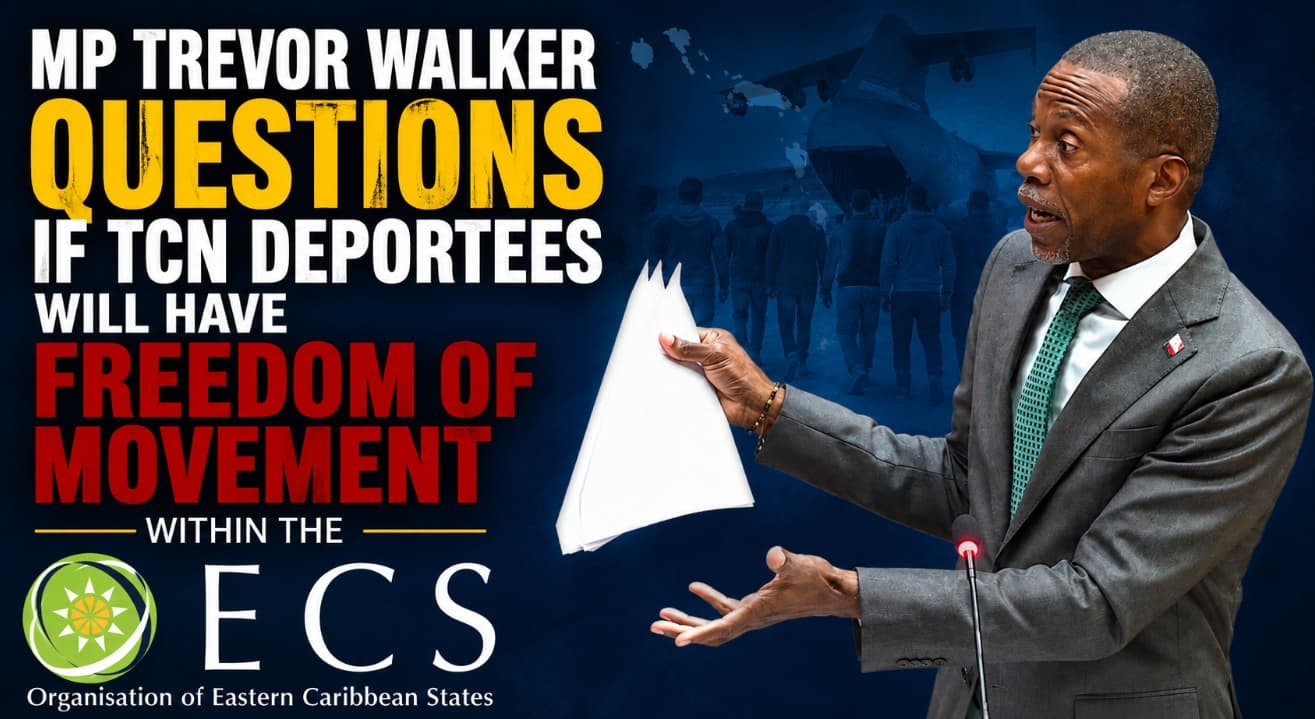
Barbuda MP Trevor Walker has placed before Parliament a question that neither the government’s white paper, the Prime Minister’s public statements, nor any OECS or CARICOM communiqué has addressed — and it may be the most consequential unanswered question in the entire third-country deportee debate.
If deportees transferred from the United States are given legal status in Antigua and Barbuda, does the OECS freedom of movement framework entitle them to travel freely across the sub-region?
“When — not if — when Antigua and Barbuda finalises this arrangement, and we would have gotten some of these deportees, are they free to move around the OECS?” MP Walker asked the House on Tuesday. “Are they free to travel from Antigua and Barbuda to Montserrat? Do they have that legal status to go to St. Kitts and Nevis if they want? We need to know.”
The government did not answer.
The Legal Reality MP Walker Identified
MP Walker’s question is not speculative. It is grounded in the existing legal architecture of the OECS, under which nationals and legal residents of member states enjoy freedom of movement across the sub-region. The OECS, governed by the Revised Treaty of Basseterre, provides for the free movement of people among member states — a framework designed to facilitate regional integration, labour mobility, and economic cooperation.
If a deportee transferred from the United States to Antigua and Barbuda is granted any form of legal status — whether residency, work authorisation, or some other documented standing — the question of whether that status automatically confers the right to move freely to Dominica, St. Kitts and Nevis, St. Lucia, Grenada, St. Vincent and the Grenadines, or Montserrat is not a hypothetical. It is a live legal question with immediate practical consequences for every OECS member state.
MP Walker made the point with characteristic directness. “So, we have a borderless situation in the OECS. So, while we’re talking about just the 14 for Antigua, what about the others who are in St. Kitts, St. Lucia, who are not comfortable there, but find out they can move throughout the sub-region once they have papers?”
The Flow Goes Both Ways
MP Walker’s framing revealed a dimension of the deportee issue that has not been at the forefront of the public discussion. The debate in Antigua and Barbuda has focused primarily on how many individuals this country might accept — ten, fourteen, sixteen — and on the background of these third-country deportees. But the OECS freedom of movement framework means the question is not just how many Antigua and Barbuda accepts. It is how many the entire sub-region accepts collectively, and whether any of them can subsequently relocate to Antigua and Barbuda from a neighbouring territory.
If St. Kitts accepts deportees and grants them legal status, can those individuals board a ferry or a flight and arrive in Antigua? If Dominica or St. Lucia accepts individuals under their own bilateral arrangements with Washington, do those individuals acquire the right to move freely across the OECS — including to Antigua and Barbuda?
The white paper is silent on this. The resolution passed by Parliament on Tuesday is silent on it. The Prime Minister’s extensive remarks to the House did not address it. CARICOM’s recently concluded Heads of Government meeting in St. Lucia produced no collective position on the deportee issue — let alone a coordinated approach to managing freedom of movement implications across the region.