Edition
Real News Antigua & Barbuda

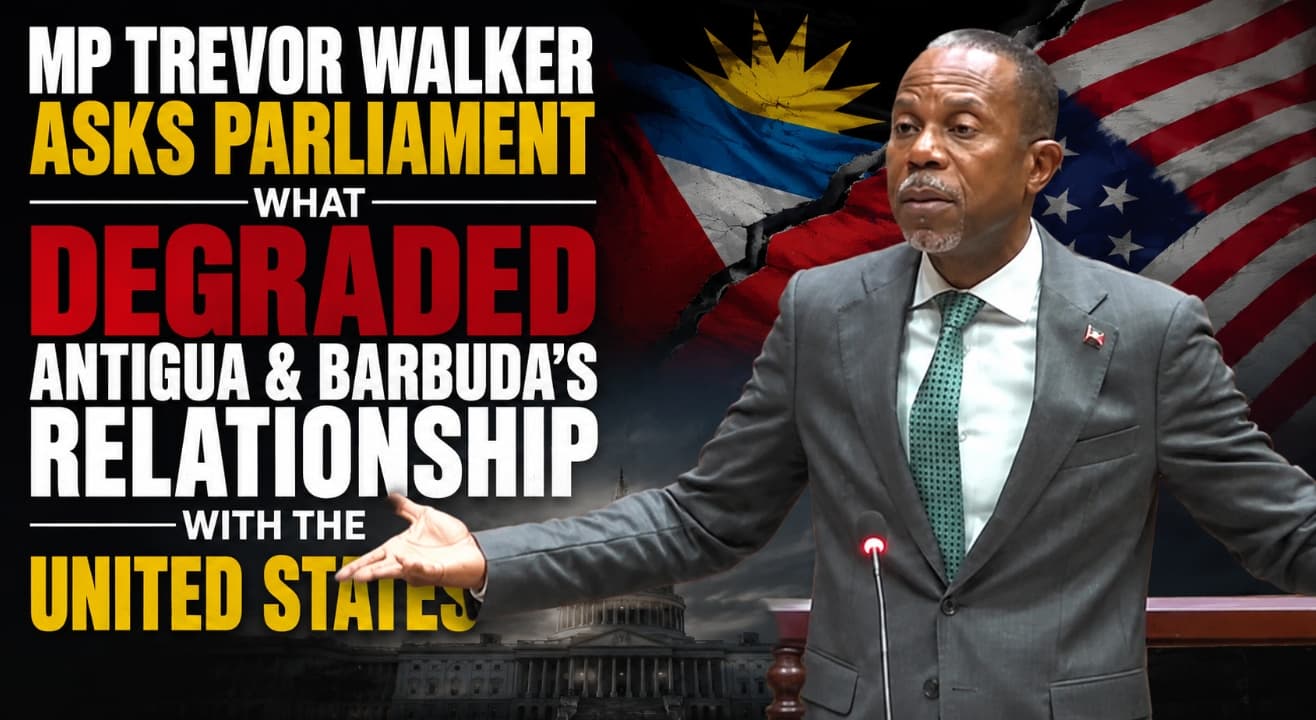
“From Publicly Commended and Admired to Restricted”: MP Trevor Walker asks Parliament what Degraded Antigua & Barbuda’s Relationship with the United States

Editorial Staff
Editorial StaffReal News Editorial Team
5 min read
ShareXFacebookWhatsApp
trevor walker asks degraded antigua's relationship with the us

Barbuda MP Trevor Walker stood in parliament on Tuesday and asked, with the authority of someone who was in the room when the relationship was at its strongest, what exactly happened between the time the United States publicly commended Antigua and Barbuda for its transparency and accountability legislation, and the present moment, in which Antiguan and Barbudan passport holders face the harshest visa restrictions in the Eastern Caribbean.

MP Walker did not speculate. He did not trade in rumour. He drew on firsthand diplomatic experience and asked the Prime Minister, directly and on the parliamentary record, to tell the nation the truth.

The Condoleezza Rice Meeting: “We Were Admired”

MP Walker transported the House back two decades to a CARICOM meeting with then-US Secretary of State Condoleezza Rice, held at Paradise Island in the Bahamas around 2005. He was there. He represented Antigua and Barbuda on behalf of then-Prime Minister Dr. Winston Baldwin Spencer.

“One of the things that was said by the Secretary of State, then Condoleezza Rice, to all of us — Ralph was there — was that the United States of America commends Antigua and Barbuda for the slew of legislation that they’ve passed in parliament that shows the world how serious they are about accountability and transparency in government,” MP Walker recounted.

He paused to let the words settle before delivering the line that gave his contribution its emotional centre.

“At that time, we were looked at as a country that was admired by the United States.”

Admired. Not tolerated. Not managed. Not restricted. Admired — publicly, by the Secretary of State of the United States, in front of the Caribbean heads of government, for the quality of the nation’s governance and its commitment to the rule of law.

“So From Then to Now, What Has Happened?”

MP Walker then asked, “So, from then to now, what has happened? Is it that the Prime Minister is telling this Honourable House, or should be telling this Honourable House, that the United States of America has serious issues with the CIP programme, and that has caused the relationship and certain things to deteriorate to a level where Antiguans and Barbudans are negatively affected? Tell us that. Let us know.”

The question was not rhetorical. It was a demand for disclosure. MP Walker was asking the Prime Minister to explain, on the record, what conduct, what policy decisions, what failures of governance transformed Antigua and Barbuda from a nation commended by the US Secretary of State for its transparency into a nation whose citizens face 30-day travel caps, visa denials for businesswomen visiting their children at university, and the most stringent immigration restrictions applied to any OECS territory.

The CIP Question Still Unanswered

MP Walker’s framing pointed directly at the Citizenship by Investment Programme. The question “what has happened?” carries its own answer in the context of everything the public already knows: the 2016 amendments that gutted the CIP’s guardrails, the removal of the Director of Audit’s oversight, the reduction of residency requirements from 35 days to 5, the stripping of applicant names and addresses from public reports, the parade of internationally controversial passport holders, and the EU’s formal demand for the programme’s phase-out by June 2028.



Advertisement

Article mid


MP Walker did not need to enumerate those facts. He simply asked the Prime Minister to be honest about whether they are the reason or a significant reason the relationship collapsed — and the Prime Minister did not answer.

What Antiguans and Barbudans Lost Between “Then” and “Now”

MP Walker illustrated the human cost of the deterioration through two personal accounts that no government statistic can capture.

The first was his own experience at Miami immigration after the April election, when an officer informed him — a Member of Parliament travelling on an Antigua and Barbuda passport — that Antiguans and Barbudans are permitted a maximum of 30 days in the United States. “I said, ma’am, I only want four,” MP Walker recalled. “Not one month — 30 days," was the reply of the US immigration officer.

The second was the story of a businesswoman he knows — financially independent, with the resources to support herself and her son at a private American university — who applied for a US visa and was denied. She can no longer visit her child. “She has an issue now going to see her son, more so in a year and a half when he graduates,” MP Walker said.

These are not policy abstractions. They are the daily consequences of a diplomatic collapse, and the people are paying the price for it.

“Leadership Is Hardship — Tell People the Truth”

MP Walker said the government’s obligation in a moment like this is not to posture or to pretend the country holds leverage it does not possess, but to be straight with the public about the situation and how it was reached.

“I’ve said to my colleagues in Barbuda all the time — leadership is hardship. There’s no nice, nice thing in leadership, and no level playing ground and fairness. Leadership is hardship. That is what it is,” he said. “So when we’re in this position, we are to be serious, and we ought to let people know what the situation is straight up.”

The implication was unmistakable. The Prime Minister has spent months framing the deportee issue as an external imposition — something being done to Antigua and Barbuda by a hostile superpower. MP Walker’s question reframes it as something that may have been caused, at least in part, by the government’s own conduct — and challenges the Prime Minister to have the honesty to say so.

From a nation admired by former US Secretary of State Condoleezza Rice for its transparency and accountability, to a nation whose citizens cannot get a visa to visit their own children at university. From commended to restricted. From trusted to pressured.

“From then to now, what has happened?”

Comments

Leave a comment

Comments are moderated before appearing.

Weekly Digest

Stay ahead of every story that matters.

Every Monday morning — the week's most important news from Antigua & Barbuda and the Caribbean, delivered straight to your inbox.

  • Breaking news & top stories
  • Politics, crime, business & sport
  • Free — unsubscribe any time

No spam. One email per week. Unsubscribe any time.

or
Join our WhatsApp group

About the author

Editorial Staff
Editorial Staff

Real News Editorial Team

Real News Antigua and Barbuda editorial team.

Advertisement

Leaderboard ad

Related articles

Advertisement

M Banner
Join our WhatsApp