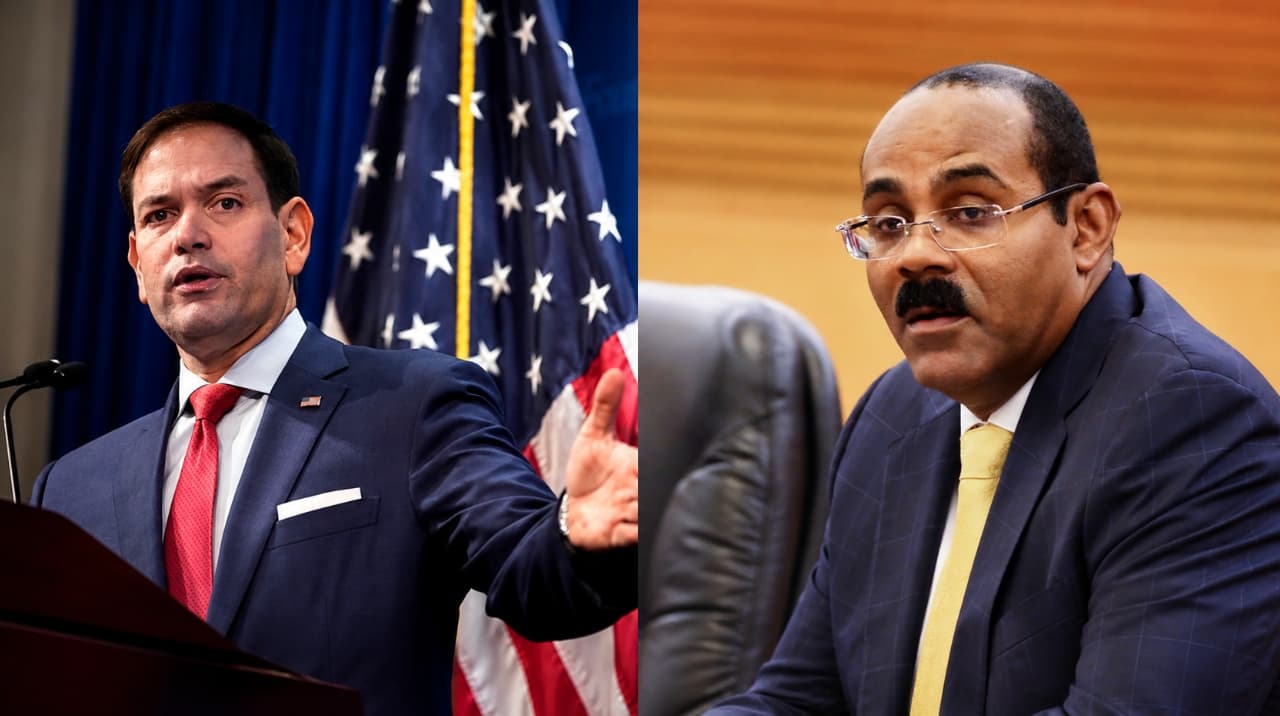
The Government of Antigua and Barbuda has achieved something remarkable: It has transformed a small island-state of limited means, limited administrative depth, and limited strategic weight into a paid janitor for American deportation policy … and then had the audacity to call it “sovereignty.”
The Operating Procedures of September 2026 are a document of exquisite cowardice dressed in the language of prudence; a masterpiece of self-deception that the Gaston Browne Administration has proudly unveiled as though it were a diplomatic triumph rather than an act of national submission.
Let us examine the architecture of this capitulation. Every clause that appears to protect Antigua and Barbuda is carefully non-binding on the United States. Every clause that imposes cost or inconvenience on Washington is framed as an "expectation," an "intention," or a hope. The United States "expects to fund." It "is expected to" facilitate return. It "intends to" provide information. This is not the vocabulary of equals. This is the vocabulary of a subordinate who has already decided that refusal is too expensive and is now negotiating the terms of its own accommodation.
The Browne Administration’s public defense has been a study in political smallness. "We retained the right of refusal." "There is no minimum number." "It is non-binding." These are the consolations of the weak, the whimpers of a government that has confused the appearance of control with its substance.
The right of refusal is exercised after the United States has assembled the dossier; after the individual has been selected; and after the political pressure to appear cooperative has already done its work.
The absence of a minimum quota is meaningless when the structure itself creates diplomatic expectation and administrative precedent.
Non-binding instruments still generate path dependence. They still create facts on the ground. They still leave residual risk sitting on the smaller party's balance sheet when the larger party's funding slows; when the implementing organization under-performs; or when the transferred person simply refuses to leave.
What the Browne Administration actually secured is a framework in which Antigua and Barbuda absorbs the practical consequences of American policy failure. Persons arrive under a temporary status whose legal architecture has deliberately been left vague. Departure depends on continued American money; the performance of a third-party organization; the willingness of third countries; and the absence of successful protection claims under Antigua and Barbuda's own international obligations.
The right to block the next arrival does nothing for those already present. Sovereignty retained at the gate is not sovereignty retained over the aftermath.
And here is where the entire edifice collapses into absurdity: If the United States can pay to transport these individuals, house them, feed them, provide medical care, fund interpreters, cover security, and sustain them for months or longer in Antigua and Barbuda and then claim it "cannot" return them to their countries of nationality, it is a fiction of convenience.
Neither money, nor aircraft, nor administrative capacity is the constraint. The United States has already demonstrated that it possesses all three in sufficient measure to underwrite third-country reception. What it lacks is the political will to compel the origin countries to accept their own nationals.
Some governments refuse travel documents. Some treat non-cooperation as leverage. Some raise legal or practical obstacles. These frictions are real. They are not, however, laws of nature. They are the product of diplomatic priorities.
When Washington has decided that returns to a particular country matter enough, it historically has found ways to raise the cost of refusal using visa restrictions, sanctions, aid conditionality, commercial pressure, and sustained high-level insistence. The decision to bypass that work and instead pay small Caribbean states to absorb the residual cases is a policy preference, not an unavoidable necessity.
By signing the Operating Procedures, Antigua and Barbuda has agreed to convert an American political and diplomatic difficulty into a Caribbean administrative and fiscal problem. It has accepted the role of paid residual handler so that the United States can maintain the fiction that the obstacle was technical, rather than discretionary.
This is not a partnership; it is the hiring of convenience. And the Browne Administration, in its desperate hunger for relevance on the world stage, has accepted the role with alacrity, then dressed it in the language of statecraft.
The numerical ceiling of seven persons per quarter is equally revealing. In a country of roughly one hundred thousand (100,000) people, with thin health services, limited housing stock, and an immigration system already stretched by ordinary demands, these numbers do not evidence restraint; they are an admission that even modest inflows can generate disproportionate strain.
The Procedures themselves concede the point by permitting immediate suspension if public order, public health, housing, or fiscal capacity comes under pressure. That such a clause was required is, itself, an indictment of the decision to enter the arrangement at all. A government confident in its capacity does not negotiate a self-destruct clause. A government that needs one has already admitted it is out of its depth.
The interaction with CARICOM Free Movement is treated as an afterthought, which is precisely how one would expect a government more concerned with bilateral optics than regional consequences to treat it. By prioritizing CARICOM nationals while excluding Haitians, the arrangement introduces persons into a legal space in which rights of entry, stay, and economic activity already exist.
The Administration appears not to have integrated this reality into its calculations – or to have decided that the risk is acceptable. Neither interpretation is flattering. One suggests incompetence and the other suggests a willingness to gamble with the rights and resources of Antiguans and Barbudans for the sake of a photograph with American officials.
The deeper humiliation is strategic. Antigua and Barbuda has no national interest in hosting people the United States finds inconvenient to return directly. The arrangement exists to serve Washington's removal objectives and to spare it the diplomatic labour of forcing origin countries to cooperate. In accepting it, Antigua and Barbuda converted a low-interest proposition into a structure of contingent liability and then congratulated itself for the formal reservations it managed to insert.
Those reservations function primarily as political cover. They allow ministers to claim control while the actual distribution of risk runs in the opposite direction. They are the fig leaf that the Browne Administration hopes will conceal the nakedness of its capitulation.
What is touted here as statecraft is the management of decline conducted with the rhetoric of prudence. A government that understood the asymmetry of power would either have refused the premise outright or extracted terms so tightly drawn, so fully funded, and so automatically enforceable that residual exposure remained with the requesting state.
Instead, Antigua and Barbuda signed a document that allows the United States to induce Antigua and Barbuda to decide under imperfect information, and leaves the long-term consequences sitting on our legal system, our fiscal capacity, and our diplomatic reputation. Gaston Browne agreed to underwrite, with its limited resources and limited sovereignty, a preference that Washington could have met by other means if it chose to do so.
And what has Antigua and Barbuda received in return? Not funding, but a nominal payment for doing Washington's dirty work. Not security, as that is a fantasy in a region where the United States has historically treated Caribbean states as afterthoughts at best and inconveniences at worst. Not respect, because that is absent from any arrangement in which one party writes the rules and the other party thanks it for the privilege.
What Antigua and Barbuda has received is the opportunity to be a footnote in a US policy document, a line item in a budget that will be forgotten when the political winds shift, a pawn in a game it does not understand and cannot win.
The Gaston Browne Administration has spent years lecturing the region about sovereignty, about the need for Caribbean nations to stand tall, to demand respect, to refuse to be dictated to by larger powers. And now, when tested, when presented with an opportunity to demonstrate the very principles it so loudly proclaimed, it folded.
It folded not under military threat, not under economic coercion, not under any pressure that could not have been resisted with courage and diplomatic skill. It folded because the allure of proximity to American power was too seductive; because the opportunity to appear important on the world stage was too tempting; because the alternative of saying no and meaning it was too terrifying for an administration that has never met a difficult decision it could not postpone or a principle it could not abandon.
This is the Administration that is telling us it will “fight fire with fire” on gun crime and will not allow Antigua and Barbuda to become a gangster place. And yet, when the United States came calling with a proposition that serves no local interest and imposes real costs on Antiguans and Barbudans, this same government rolled over like a puppy, a paper tiger, a bully at home and a supplicant abroad.
The Operating Procedures will be praised by those who benefit from proximity to power. They will be defended by those who cannot imagine saying no to Washington. They will be explained away by those who have made careers of explaining away the Administration's failures. But history will record that Antigua and Barbuda, under Gaston Browne, chose servitude and called it wisdom. But this is to be expected, as Government has long since traded its conscience for the illusion of relevance.
The people of Antigua and Barbuda deserve better. They deserve a government that understands that sovereignty is not a slogan to be trotted out at election time, but a responsibility to be exercised every day. They deserve a government that will say no when saying yes costs too much. They deserve a government that will treat the United States as a partner, not a patron. They do not have one, and they should remember that fact the next time they are asked to vote.