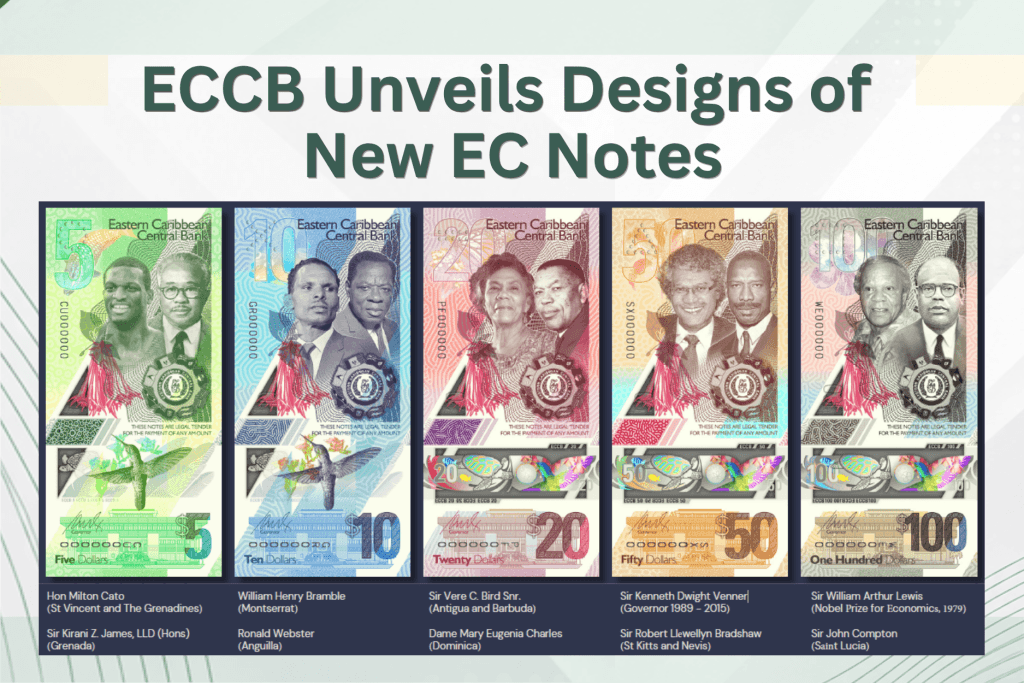
The face of the Eastern Caribbean dollar is changing — literally. For the first time in the currency's 42-year history, the banknotes that circulate across eight Eastern Caribbean nations will no longer carry the image of the late Queen Elizabeth II, replaced instead by the faces of ten distinguished Caribbean national heroes, nation builders, and regional icons.
Governor of the Eastern Caribbean Central Bank Timothy N.J. Antoine unveiled the redesigned banknotes on Wednesday during the Ceremony to Mark the Change in Chairmanship of the ECCB Monetary Council, held at the InterContinental Dominica Cabrits Resort — describing the new series as a powerful tribute to the people, heritage, and achievements of the Eastern Caribbean Currency Union.
Who Will Appear on the Notes
Each denomination will feature dual portraits of two prominent figures from across the ECCU member states.
The EC$100 note will feature Nobel laureate in economic sciences Sir William Arthur Lewis, and The Right Honourable Sir John George Melvin Compton — the former Prime Minister of Saint Lucia who was born in St. Vincent and the Grenadines.
The EC$50 note will feature former ECCB Governor Sir K. Dwight Venner, who led the bank from 1989 to 2015, and St. Kitts and Nevis National Hero Sir Robert Llewellyn Bradshaw.
The EC$20 note will carry Sir Vere Cornwall Bird Sr., the first Prime Minister of Antigua and Barbuda, and Dame Mary Eugenia Charles, former Prime Minister of Dominica — notably the only woman to feature on the redesigned notes.
The EC$10 note will feature William Henry Bramble and James Ronald Webster — pioneering leaders from Montserrat and Anguilla respectively.
The EC$5 note will feature Robert Milton Cato, the first Prime Minister of St. Vincent and the Grenadines, and Sir Kirani James, Grenada's Olympic gold medallist — the only living person to appear on the new banknotes.
V.C. Bird on the EC$20: A Moment for Antigua and Barbuda
For Antigua and Barbuda, the appearance of the late Sir Vere Cornwall Bird Sr. on the EC$20 note — one of the most commonly used denominations in everyday transactions across the ECCU — carries deep national significance. The founding father of the nation, Sir Vere led the country to independence in 1981, served as its first Chief Minister, first Premier and first Prime Minister, and remains the most towering figure in Antiguan and Barbudan political history. That his image will now circulate in the pockets and purses of citizens across eight Eastern Caribbean nations is a fitting recognition of his contribution not only to Antigua and Barbuda but to the region.
A Decision Rooted in Public Consultation
The redesign follows a decision taken by the Monetary Council at its 105th Meeting on July 21, 2023, to approve the replacement of Queen Elizabeth II's image on the EC currency. Public consultations conducted between July and December 2023 confirmed strong public support for featuring national heroes and nation builders on the redesigned currency.
When the Notes Enter Circulation
Circulation of the redesigned notes is expected to begin in late 2027, with the EC$100 note expected first, followed by the remaining denominations as existing stocks are used up through normal wear and tear — ensuring a gradual and orderly transition.
The ECCB said the new series preserves the security, integrity, and trust that have long defined the EC dollar while honouring the cultural diversity and enduring legacy of the people who shaped the Eastern Caribbean.
The unveiling marks one of the most symbolically significant changes in the history of the EC dollar — a currency that has served as the common monetary thread binding eight nations together since 1983. From late next year, every note that changes hands in a market in Dominica, a bank in St. Kitts, a shop in Grenada, or a vendor's stall in Antigua will carry not the face of a distant monarch, but the faces of the Caribbean men and woman who built the nations those notes serve.