Opposition Leader MP Jamale Pringle has warned the people of Antigua and Barbuda that the government’s own White Paper on third-country deportees exposes a devastating legal reality — the country has no legal framework to accommodate the individuals it is preparing to accept, meaning anyone transferred here could become permanently trapped in a limbo that Antigua and Barbuda’s laws were never designed to resolve.
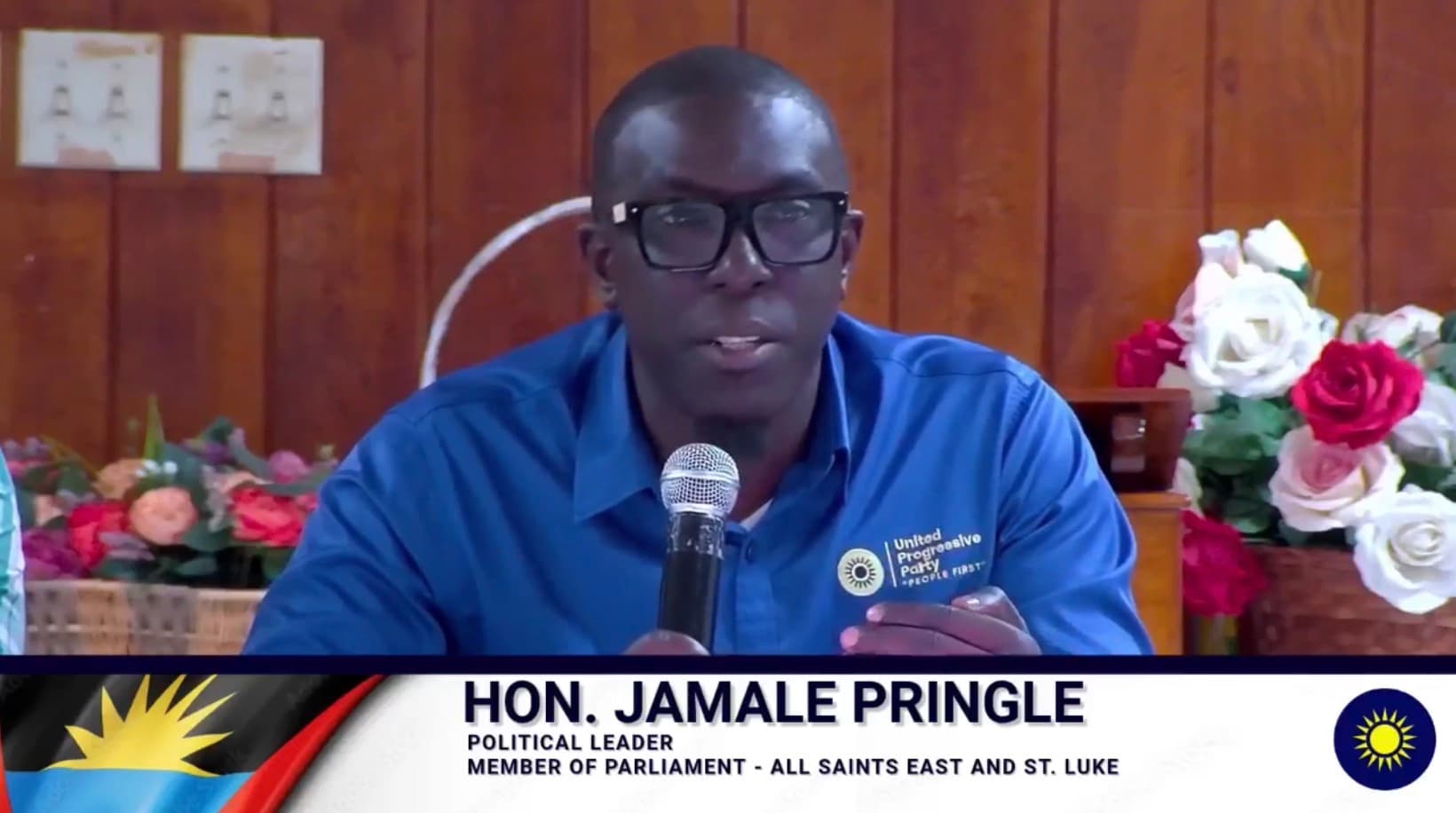
MP Pringle, the Political Leader of the United Progressive Party and Member of Parliament for All Saints East and St. Luke, delivered the warning during Thursday night’s town hall at the Moravian Conference Centre on Cashew Hill — the first public consultation held by any political party on the deportee issue ahead of the parliamentary sitting on Tuesday 14th July.
“We Are Not Worthy of Perusing That Document”
MP Pringle opened by grounding his remarks in a principle he said was non-negotiable: he cannot speak on behalf of the people without first hearing from them. “I don’t believe I can speak on your behalf, not hearing from you. And I don’t think speaking on my own behalf, I will be representing you,” he told the audience.
He then turned to the document at the centre of the controversy — the White Paper — and laid bare what he described as its most fundamental flaw: Parliament and the public are being asked to debate an arrangement while the actual agreement that governs it has never been disclosed.
“While we have in our possession the white paper, the MOU that this white paper speaks to has been missing. We are yet to see what that document entails,” MP Pringle said. “This is not a document that was signed two weeks ago. We’re looking at this document being signed on December 19, 2025, described as an expressly non-binding agreement, but yet still, the actual text of the MOU remains private.”
The implication, he said, is that elected representatives are being asked to debate and approve an arrangement based solely on the government’s own summary of it. “So we are going to discuss an agreement that all we can discuss about the agreement is what the government is telling us about the agreement. So we are not worthy of perusing that document for ourselves.”
The Legal Trap the White Paper Itself Admits
MP Pringle’s most consequential contribution came when he turned the White Paper’s own admissions against the government. He told the audience that the document reveals Antigua and Barbuda lacks a standalone refugees act, has no legal mechanism to resolve statelessness, and possesses no domestic legislation specifically designed to accommodate the categories of individuals the United States is seeking to transfer.
“According to the white paper, Antigua and Barbuda lacks a standalone refugees act. So therefore, there is no legal mechanism to resolve statelessness,” MP Pringle said. “The document describes a legal trap where a transferred person who cannot be deported to their home country or returned to the US becomes non-removable, potentially trapping them in indefinite detention or irregular status.”
He broke the implications down in plain terms: “So this means, even if one person — whereas the government proposes up to 10 initially as a one-off, which now has moved to 16 per year — this triggers significant international treaty obligations that the country currently has no domestic legislation specifically designed to fulfill.”
His conclusion was stark: “Legally, we are taking them, or we are just accepting. But legally, we cannot do anything for them. You cannot give them status because we don’t have any mechanism in place in Antigua and Barbuda. No law in place to facilitate such.”
“I Don’t See the Skillful Negotiation in this Document”