St. John's, Antigua — May 29, 2026
The long-running legal battle by Barbudan land defenders to protect their island from billionaire-backed luxury developments is set to return to court next week, with multiple cases winding through the Eastern Caribbean judicial system that advocates say could determine the future of Barbuda's unique communal land tenure and fragile natural environment.
The litigation involves several interconnected disputes, all rooted in a wave of ultra-luxury development that accelerated in the aftermath of Hurricane Irma's devastating strike on Barbuda in 2017. Ever since, ultra-wealthy developers have been fencing off vast stretches of the coastline for their projects, with the government having forcibly evacuated residents despite many wanting to remain — a move critics described as disaster capitalism.
At the centre of one case is a Barbudan landholder whose beachfront property in the Dulcina area has been targeted by Murbee Resorts Inc, the developer behind the planned luxury Rosewood Barbuda hotel. The land sits on a pristine beach renowned for its unique pink sand. Murbee Resorts Inc is owned by Purcell Bird, the father of Housing and Lands Minister Maria Browne, who is the Prime Minister's wife. The Rosewood Barbuda project is slated for at least 85 acres of Barbudan beachfront land, including fifty resort suites and thirty-five Rosewood residences. The landholder alleges that developers bulldozed their small business infrastructure — a cottage and bar — without consent, and that the company's lease may in fact overlap their private plot, meaning it should never have been granted.
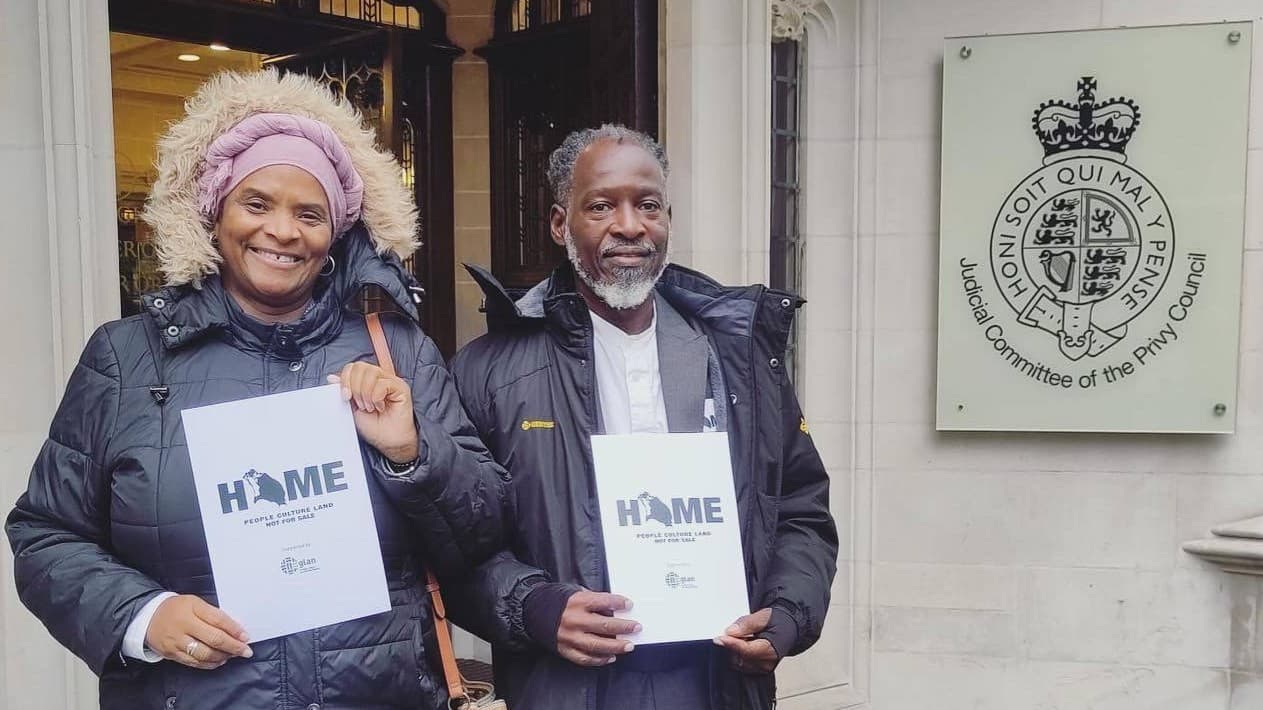
A second front involves land defenders John Mussington and Jacklyn Frank, who are challenging the construction of a private jet airport built while residents were still displaced following Hurricane Irma. Following their landmark win at the London-based Privy Council — which ruled they had standing to bring their challenge — John and Jackie have taken their case to the High Court of the Eastern Caribbean, pushing back against the government who, alongside big developers, side-stepped environmental concerns and planning rules to build the airport. The new airport, serving ultra-wealthy tourists, was built over aquifers, threatening the island's underground water reserves, and was constructed without any consultation with Barbudans.
The Peace, Love, Happiness (PLH) development — backed by billionaire John Paul DeJoria and Casamigos co-founder Michael Meldman's Discovery Land Company — contributed $5 million USD to the airport's construction, intended to provide access for ultra-wealthy villa owners.
A third case concerns Codrington Lagoon National Park, where GLAN and Barbudan land defender, fisherman and tour guide George Jeffery have initiated legal proceedings against the Development and Control Authority over the approval of a luxury villa being built by an English millionaire at Cedar Tree Point — a Ramsar Convention protected wetland and home to Barbuda's magnificent frigate bird sanctuary.
The court heard how endangered frigate birds, rare turtles and other species' nesting sites on Barbuda's protected wetland are being negatively impacted by construction, and that the government overruled environmental assessments and advice to push the project through.
The Global Legal Action Network (GLAN) is supporting the Barbudan defenders across the cases. Gulliver Johnson of the Barbuda Land Rights and Resources Committee said: "The claimant is incredibly brave to stand up to these developers, and we back this case, and every Barbudan who wishes to assert his or her rights to our land via the courts to challenge these environmentally harmful developments. The road ahead is long, but Barbudans are resilient and are up for the fight."
Underlying all the legal battles is a deeper struggle over the future of Barbuda's centuries-old tradition of communal land ownership — a system that advocates say has long protected the island's ecological character, but which the central government on Antigua is seeking to dismantle by changing the law to remove communal ownership and transfer land control to the government.
Sources: Antigua News Room, Global Legal Action Network (GLAN), Antigua Observer