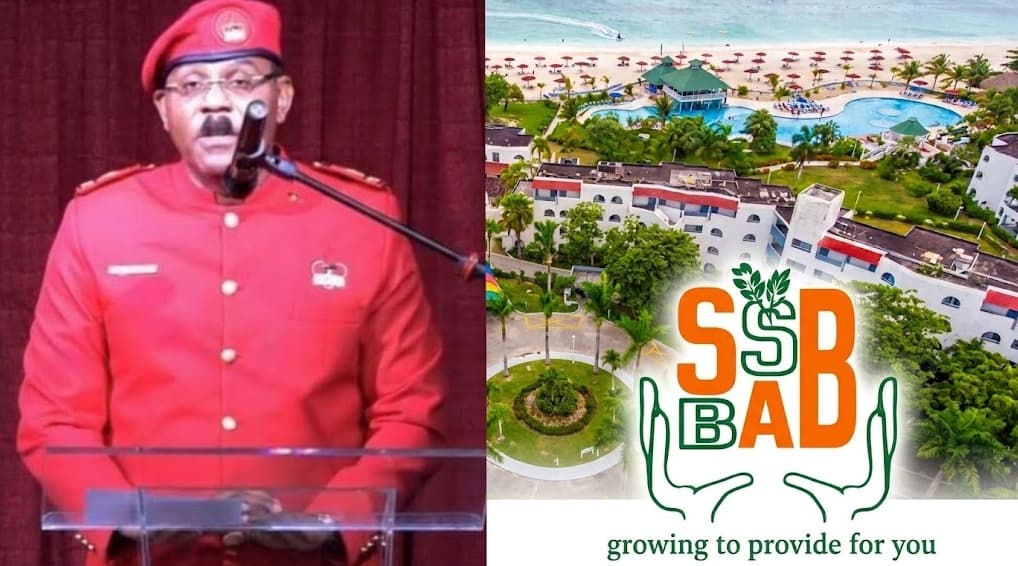
Prime Minister Gaston Browne has admitted that the ownership of the Jolly Beach Resort has not been transferred to the Social Security Board and that it was the sustained objections of the parliamentary opposition and the outcry from ordinary citizens that stopped his government from going through with it.
The concession came during Prime Minister’s Questions at Monday’s sitting of the House of Representatives, as Opposition Leader Jamale Pringle pressed the Prime Minister on whether the government is current on its contributions and bond obligations to the Social Security Scheme and if the Jolly Beach Resort had yet been transferred to Social Security.
“Because [of] all of the noise that was made initially and the rejection of the proposal by members of the opposition… the government had chosen not to proceed to vest the said property… in Social Security,” PM Browne told the House, before adding: “It doesn’t necessarily mean that it may not be done in the future.”
In the same exchange, the Prime Minister disclosed that a new bond arrangement of more than $400 million is being negotiated with Social Security, with terms he hopes will be finalised before the end of the year.
The admission is a striking one. For the better part of two years, the Browne administration dismissed critics of the Jolly Beach plan as alarmists and political opportunists, and used its parliamentary majority to pass the resolution authorising the transfer. Now, by the Prime Minister’s own account, it is precisely those objections — raised by the United Progressive Party (UPP) inside and outside Parliament, and echoed by pensioners, professionals and members of the general public — that caused the government to quietly shelve the centrepiece of its plan to shore up the troubled fund.
From “Strategic Imperative” to Shelved Plan
The proposal at the centre of the storm was first announced in June 2025, when Cabinet revealed that 75 million dollars in Social Security funds would be injected into the Jolly Beach property. The plan, as outlined by Director General of Communications Maurice Merchant, was ambitious: transform Jolly Beach into a 500-room resort, sell condominiums through the Citizenship by Investment Programme (CIP), and make the Social Security Scheme the owner of the property.
The government’s pitch rested on two claims: that Jolly Beach, operating below capacity with the assistance of a private hotelier, had turned a profit of roughly $1.5 million in its previous year of operation, and that an ageing population — with citizens living longer and the retirement age set at 65 — made diversifying the scheme’s revenue streams a necessity.
By August 2025, the Prime Minister had refined the architecture of the deal. In a glossy booklet titled “The Transfer of Jolly Beach to Social Security — A Strategic Imperative,” PM Browne — who is also Minister of Finance — proposed exchanging the resort for a portion of the government’s non-performing EC$330 million bond held by Social Security, at a set-off value of EC$137.7 million (US$51 million). A ten-year sales plan, he wrote, would deliver net receipts of EC$392.75 million into a dedicated third-party escrow account — more than twice the EC$192.3 million residual that would remain on the bond — while strengthening the scheme with “a reliable, above-inflation revenue stream.” He branded the model “Empowerment Capitalism” and said he was “flabbergasted” that some in the general public were against the proposal.
The road to Parliament, however, was anything but smooth. A sitting scheduled for early August 2025 was abruptly postponed before the resolution finally came up for debate on August 25, 2025. When it did, every opposition MP who was present raised their voice against it.
“Where is the Evaluation?” — MP Pringle’s Case in the House
When the resolution reached the floor on August 25, 2025 — with opposition supporters staging a protest on Queen Elizabeth Highway — PM Browne mounted a bullish defence. He projected that Social Security would generate a $60 million annual surplus from 2026, claimed the EC$137 million transfer would yield some EC$400 million over ten years through hotel operations and CIP unit sales, asserted that there had never been a real estate crash in the country’s history, and promised a written central government guarantee to cover any shortfall if, in his words, nobody bought the units.
Opposition Leader Jamale Pringle was unpersuaded. His central objection was that the government was asking Parliament to approve a transaction without critical documents. “Where is the evaluation of Jolly Beach? ” he asked, noting that the promised valuation of the property had never been provided to members ahead of the debate.
MP Pringle’s second line of attack turned the government’s own booklet against it. If the West Indies Oil Company had paid out $160 million in dividends over the years, as the document boasted, why gamble on turning around a shuttered hotel when profitable, dividend-paying state assets already existed? The opposition, he said, could only support the resolution if the government instead transferred shares in WIOC and other successful statutory corporations into Social Security — assets that would give the scheme an immediate, income-producing injection — and laid its full plans before the public first. He also raised a technical objection that cut at the deal’s legal foundation: reducing the principal of the 2010 bond through an asset swap, he argued, would violate term two of the 2010 bond made law by its approval and ratification by parliament.
MP Pringle had been prosecuting the case for months. In June 2025, he told the Observer the party had “no confidence” in the government’s stewardship, warning that a “hit-or-miss” venture was no place for the cash-based fund that pays pensioners. After the vote, he sharpened the argument further on Observer AM, branding the deal “dubious” and “ill thought out” and laying out alternatives: a Social Security Mortgage and Trust lending to citizens for land acquisition at rates below the commercial banks; the direct assignment of Citizenship by Investment files to the scheme; and the transfer of performing state shareholdings. “If, for example, Social Security were liquid and had the reserve that could facilitate a shock of that investment, I would support it,” MP Pringle said but not when the government itself was calling the investment the scheme’s lifeline. He also revealed that an independent report by an attorney and intellectual, urging the Prime Minister to halt the deal, had found the proposal riddled with methodological flaws, overly optimistic projections and inadequate risk assessment.
MP Walker: A Vote Without the Books
Barbuda MP Trevor Walker, whose Barbuda People’s Movement sits alongside the UPP on the opposition benches, trained his fire on process. His position mirrored MP Pringle’s conditional stance: the opposition could contemplate the plan only if comprehensive documentation and full financial transparency came first.
MP Walker catalogued what was missing from the table of the House: the Social Security Fund’s audited financial statements from 2014 to 2024, its actuarial reports for the past decade, and any detailed recommendation from the Social Security Board itself on the very transaction members were being asked to approve. He told the Speaker he would “love to receive” the Board’s formal response and recommendations, adding that if the Board had reservations about the deal, the public was entitled to know what they were.
MP Walker’s complaint had been vindicated earlier through the PM Browne's confession during that same August 25 parliamentary sitting. During Prime Minister’s Questions PM Browne conceded under questioning from MP Pringle that he was in receipt of Social Security’s financial statements for 2014 to 2024 but had not laid them before the House as section 17 of the Social Security Act requires. “I’ll accept that we have been tardy in filing those financial statements,” the Prime Minister said, as recorded in Hansard, adding that the reason they had not been filed “is because there’s an adverse opinion” from the auditors. He likewise admitted that the actuarial reviews mandated by section 18 had not been laid, even while confirming, “We not only received them, we read them.”
In other words: on the day Parliament was asked to judge whether handing a hotel to Social Security would secure the fund’s long-term viability, members did so without a single audited statement, actuarial review or statement of securities for the preceding decade available to them — documents the law requires the Minister of Finance to table, documents which the Minister of Finance acknowledged were being held in his possession.
MP Bowen: An Insolvent Fund, a “Failed Asset” and an Unpaid 49-Year-Old Debt
The most fundamental attack came from Sherfield Bowen, then the MP for St Philip’s South and the UPP’s Deputy Political Leader, who brought his training as both an attorney-at-law and an accountant to bear on the government’s numbers. MP Bowen argued that the Social Security Fund was, in substance, insolvent — and that an insolvent pension fund has no business making any major commercial investment. As for the government’s glossy booklet, he pronounced the paper it was printed on worth more than the concept inside it.
He then took the sales plan apart. The document recorded Jolly Beach as having 318 operational rooms and 32 non-operational ones, and rested on selling rooms to investors who would pay the full purchase price — figures running to $900,000 — for the right to occupy their room for a mere two weeks each year, with the unit reverting to Social Security for the other 50 weeks. MP Bowen likened the pitch to selling the Brooklyn Bridge, telling the House no rational buyer would pay half a million dollars or more for a fortnight’s annual use, and that the scheme would not fool a five-year-old. His prescription was simpler: the government should stop engineering swaps and simply pay the money it owes the fund, rather than parking what he called a failed asset on its books.
Then came the history lesson that dominated headlines from the debate. Reading from Hansard and Social Security's audited statements of 1976, MP Bowen told the House that David Kelsick, who was the director of the Social Security Board in 1976, refused a request to lend Social Security’s money to buy the Halcyon Cove hotel and resigned on October 11, 1976. The fund’s entire surplus that year, MP Bowen said, stood at $4,271,804. Almost immediately after Director Kelsick’s departure, $4,230,000 of the surplus— virtually every dollar — was lent to a company called Antigua Isle Company to purchase Halcyon. “Not a penny was paid back to today, 49 years later,” he declared using the financial statements of the Board to support his statement. By his own analysis, that single unpaid loan, with interest, now amounts to $100 million owed to the scheme. “Social Security was bankrupt from that very day,” MP Bowen declared.
The claim brought PM Browne to his feet on a point of elucidation. Antigua Isle, the Prime Minister insisted, is owned exclusively by the government and people of Antigua and Barbuda; Hugh Marshall, he said, was a minister of government serving as a director on behalf of the state, and it is standard practice for public servants — the financial secretary, the accountant general — to hold shares nominally for the Crown. MP Bowen was unmoved. He told the House he had paid more than $600 to copy the Antigua Isle's corporate records, which listed Hugh Marshall, Lyston Jacobs and Bernard Percival as the shareholders — “on behalf of nobody,” he said — with nothing in half a century of filings recording any government interest. He offered to lay the documents on the table of the House.
Town Hall at Freedom Hall: Harold Lovell’s Indictment
The opposition’s case was never confined to the parliamentary chamber. On June 24, 2025, two months before the parliamentary debate, the UPP took the deal apart in public at a packed town hall at the Antigua and Barbuda Workers’ Union Conference Center, Freedom Hall, carried live on Progressive 107.3 FM and streamed online. Hosting and moderating the forum was Jonathan Wehner, now an Opposition Senator, who opened by promising the audience the facts “unblemished, untarnished, untwisted, and unredacted.” On the panel sat attorney-at-law and former Minister of Finance Harold Lovell, former Social Security Board chairman and esteemed figure within the banking sector Everett Christian, and attorney-at-law and chartered accountant MP Sherfield Bowen.
The organizers played the government’s own words back to the room: Maurice Merchant announcing that Social Security would become the resort’s new owner, and clips of PM Browne claiming the dilapidated hotel had made a $4 million profit in 2024, could generate $8 million annually once improved, and would be swapped for the underperforming “junk bond” he blamed on the UPP, the party he accused of collapsing the scheme in 2010. The panel was unmoved. “This is our people’s money, workers’ money and it’s being gambled,” Christian warned, cautioning against injecting the scheme into a commercially risky tourism venture without consultation or transparency.
Lovell’s verdict was blunter still. “There’s no public tender, no independent valuation, and no consultation with contributors; this is financial recklessness!” he declared, asking how the government could call Jolly Beach a performing asset when its financials were unclear and its management opaque. He zeroed in on the administration’s shifting profit claims — first $1.5 million, later $4 million — demanding to know whether the figures were audited or simply being made up as the government went along, and reminding the room that Jolly Beach had historically been a loss-maker. The proposal, he said, was a “poison chalice”: attractive on the outside, but one that contributors — pensioners, mothers awaiting maternity benefits, the disabled — would be left to drink if the venture failed. Board members, he revealed, had been shown neither audited accounts from the hotel’s current operator nor a formal valuation of the property; and NAMCO, the state investment company built precisely to carry development risk, had filed no financial reports since its creation in 2016.
The town hall was also walked through the ledger of who actually paid into the scheme. Between 1976 and 2004, Lovell said, the Antigua Labour Party (ALP) administration paid in a total of $11,921,838 — $5 million of it as land at Paynters in 1995, $5 million in cash in 1996 that had itself been borrowed from Social Security, and $1 million in 1997. The UPP administration, by contrast, paid in $122,770,268 in its ten years in office — ten times as much in a third of the time. “We need to stop playing games as far as social security is concerned; people need to just know the facts,” he said, putting the scheme’s debt at $464 million by 2003 — the product of 28 years of ALP administrations withholding contributions and taking money out.
Lovell had been sounding the alarm for weeks on the airwaves as well. On Observer AM he branded the plan “scandalous and outrageous” — “I’ve seen this movie before; it has a sad ending” — and laid out the legal architecture the government was trampling: the Social Security Fund is a trust fund owned by the workers and employers who pay into it, managed by law through a tripartite board of government, union and business representatives — not by Cabinet decree. “It’s not the government’s money, it’s your money,” he said. Pension investing, he argued, rests on three principles — safety of principal, liquidity and rate of return — and a hotel fails the test: when pensioners must be paid, “you cannot go to Jolly Beach and say, I need $40,000 now.” Tourism, he warned separately, is a volatile, dice-throw sector — a single-asset, casino-style bet with no safeguards — and turning the scheme into a hotel operator was a role for which it had neither mandate nor expertise. He noted that the government had already accumulated more than $500 million in debt to the fund between 1976 and 2004 warning that should this proposal to transfer ownership of the Jolly Beach Resort to Social Security to erase the government's existing debt would be detrimental to the contributors and beneficiaries of the Social Security Fund.
“The Fracture that Broke Social Security”: MP Bowen’s Ledger
Where Lovell supplied the principles, MP Bowen supplied the forensics. The audience was first taken back to the scheme’s origins: an Act of Parliament passed in 1972 under the Progressive Labour Movement, doors opened in April 1973, replacing the old poor-relief system with pensions, sickness and maternity benefits for working people. For its first three years the fund ran cleanly so cleanly that when voices urged Premier George Walter to dip into it ahead of the 1976 election, he and colleagues such as Robert Hall refused on the principle that trust funds could not be used for electioneering.
Then, MP Bowen recounted, came the raid. Beginning with the $4,230,000 Halcyon Cove loan in 1976 — the hotel titled to the government rather than the scheme, repayment promised at $38,000 a month over 15 years at 8 percent, a loan that should have been extinguished by 1992 but stood at $12,415,145 when the UPP took office in 2004 with nothing paid. MP Bowen read out a catalogue of borrowings that were never honoured: $80,000 to purchase ZAL-TV, now ABS, ballooning to $259,000; $200,000 for CMC equipment, grown to $641,000; a $170,000 six-month loan to the Antigua Sugar Industry Corporation still unpaid 28 years later at $623,000; a $17 million loan for the Development Bank with principal and interest untouched; $1 million, and later $10 million in equity, for the National Mortgage and Trust Company; a string of 1979 borrowings to meet monthly public salaries that climbed to $1.3 million and remained outstanding a quarter-century later; $3 million for plywood after Hurricane Luis that grew to $4 million; and $21 million more for the airport and infrastructure.
“These were not paid, they were not honoured, they were not respected, they were not even collated,” MP Bowen said of the debts, which had to be hunted down loan by loan when the UPP came to office. At the end of that reconciliation, in 2005, $330 million was outstanding to Social Security — the sum the Lovell-era government consolidated into the now-famous 2010 bond.
That bond was itself on trial at the forum. In a clip played for the audience, PM Browne dismissed it as an underperforming “junk bond ” issued by then Minster of Finance Harld Lovell, on which, according to PM Browne, not a cent had been paid, carrying interest of roughly 3 percent. MP Bowen dismantled the PM's claims of nonpayment by the UPP administration by reading from the Director of Audit Reports for the years 2013 and 2014 which showed the UPP administration had reduced the principle by over 30 million dollars. MP Bowen then refuted the PM's statements of a nominal 3 percent interest rate by reading the instrument’s actual terms as laid in Parliament: semi-annual interest of 1 percent per annum from July 2010 to 2013, stepping up to 2 percent until 2015, 3 percent until 2017, 4 percent until 2019, 5 percent until 2021, and 6 percent thereafter. The bond, in other words, should have been earning Social Security 6 percent a year for the past five years. Instead, MP Bowen said, the government’s own budgets going back to 2016 still record the rate at 3 percent — and even that understated interest has not been paid. “All of these monies taken out of social security is the fracture that broke social security,” he concluded.
Beyond the Vote: What the Fight Exposed
The Prime Minister’s climbdown is all the more striking because the problems the transfer was meant to solve have not gone anywhere, and the fight over Jolly Beach dragged them into the open. Chief among them is the state of the fund itself. Addressing the House during the very same August 25 debate, Social Security’s Executive Director David Matthias warned that without greater investment returns the scheme faces “forced disequilibrium” — payouts overwhelming contributions — by 2029 or 2030, forcing yet another round of parametric changes. The arithmetic he laid out is unforgiving: 47,000 contributors support 12,000 pensioners, far below the ten-to-one ratio a properly funded scheme requires; the gap can only be closed by investment returns of 6 to 10 percent; and there is no room, in his judgment, for contribution rates above 20 percent or a pension age approaching 70. Notably, Director Matthias put the scheme’s monthly surplus at $1 million to $1.5 million — a fraction of the roughly $5 million a month in surplus cash flow the Prime Minister projected from the same floor.
The valuation question MP Pringle raised in Parliament has never been answered either, and voices outside politics kept asking it. Sir George Ryan, a former Jolly Beach shareholder and a renowned entrepreneur in Antigua, told Observer radio the reported $900,000-per-room renovation cost was “totally impossible Nobody in Antigua has a house with one room costing them $900,000,” he said, quipping that only gold fixtures could justify the price. Sir George estimated the entire 25-acre seafront property, buildings included, at just over $30 million: a figure that sits awkwardly beside the EC$137.7 million set-off value at which the government proposed to transfer it. The government’s own profit claims for the resort, meanwhile, migrated from $1.5 million to $4 million without an audited statement ever being produced to support either number.
The episode has also strained the machinery of governance around the fund. Last month, PM Browne revealed on radio that he had ordered the removal of Social Security Board chairman Kem Tonge over the saga complaining that Tonge sat through the town hall at Freedom Hall taking notes and “didn’t utter a single word ” in the deal’s defence, and that neither the chairman nor any board member turned up to a Cabinet-arranged inspection of the resort. The admission lent weight to what MP Walker had flagged in the debate: the board of the statutory body at the centre of the transaction never publicly recommended it. It also crystallized the tension Lovell had warned about — between a tripartite board’s fiduciary duty of independent stewardship and a Prime Minister’s expectation that his board appointees “fight” for his political proposals.
The transparency fight, meanwhile, has outlived the resolution. And early in 2026, the opposition announced their intention to table a private member’s motion that would compel the Finance Minister to lay before the House every outstanding audited financial statement, actuarial report and statement of securities of the Social Security Fund since 2014 — documents the motion notes the Prime Minister has admitted are in his possession — and condemning his admission that the auditors’ “adverse opinion” is his reason for withholding them. MP Bowen stated, “How can any informed and prudent decision be made without those critical documents? "
For contributors and beneficiaries of the fund, none of this is academic. As far back as December 2024, before the Jolly Beach plan was even announced, a retired LIAT worker stood alone outside the Social Security office on upper Long Street with a placard reading “All I want for Christmas is my pension from Social Security,” having waited eight months after filing for benefits she had paid toward for forty years. “Every time I call, there’s a different answer,” she told the Observer. It is people like her and other pensioners, expectant mothers and sick workers the scheme exists to protect who hold the real stake in how this contest between PM Browne's Jolly Beach proposal and fiduciary caution is resolved.
Where Things Stand
Thirteen months after the government used its majority to pass the resolution, the legal position is an odd one: Parliament has answered “yes” to the question of whether Jolly Beach should be vested in Social Security, and the government has simply declined to act on its own answer. The Prime Minister’s framing on Monday — that “all of the noise” and the opposition’s rejection led the government to hold off, though it “doesn’t necessarily mean that it may not be done in the future” — keeps the transfer alive as a possibility while conceding that, for now, the critics have prevailed.
What replaces it is familiar. The $400-million bond PM Browne says is being negotiated with Social Security — terms to be finalized, he hopes, before year’s end — would consolidate the state’s arrears into yet another obligation to the fund. It would be issued by a government that spent the past year deriding the last such instrument, the 2010 bond, as non-performing “junk” and whose own budgets, by former MP Bowen’s account, have under-recorded and under-paid that bond’s interest for a decade. Whether the new bond will be honoured where the old was not is now the central question hanging over the scheme.
The rest of the ledger remains open: the audited financial statements, actuarial reviews and statements of securities from 2014 onward that the law requires — and the Prime Minister admits holding — have still not been laid before the House and the fund’s own executive director has put a deadline of 2030 on finding investment returns the scheme has never come close to earning.
On the evidence of Monday’s Prime Minister’s Questions, the objections of the UPP, the objections of the professionals who dissected the deal at Freedom Hall, and the objections of the ordinary contributors and beneficiaries who made “all of the noise” were enough to stop the transfer of a hotel.
Whether their voices will be enough to secure the tabling of the withheld accounts and to secure the future of the Social Security Fund itself is a story still being written.